


A Webspinner e-book · November 2026
The Cost and Control of Enterprise AI
A Webspinner guide to sovereign AI, AI FinOps, and governed production workloads
Read free online. Download the PDF to keep.
Part 1
The problem: what AI adopters face
Chapter 1Executive summary: the AI cost and control challenge

This chapter sets out the problem the rest of the book answers. It shows why enterprise AI spending is hard to see, hard to forecast and hard to govern; why the cloud playbook does not carry over intact; and why the right response is not to slow AI down but to own the capacity, instrument the work and put procedure around the model. Part 2 describes the Webspinner platform that does this. Part 3 describes the engagement model and the value it is meant to produce.
The budget nobody can forecast
McKinsey and QuantumBlack open their July 2026 paper with a scene that will be familiar in most large enterprises: a leadership team approves a new AI capability, someone asks what it will cost, and the room goes quiet (Pankaj Sachdeva et al. 2026). That silence is not a communication failure. It is a structural one. AI consumption is distributed across business units, embedded in workflows built outside central IT, and priced per token by vendors whose unit of sale does not map to any line in the finance system.
Exhibit 1
Adoption scaled faster than budget control

What to notice
- Dozens of invoice envelopes from separate business units: spend is bought outside central IT.
- The single closed budget folder at the table edge: control artefacts no longer match where spend originates.
- The analyst's screen shows abstract consumption bars: telemetry exists but is not reconciled to finance lines.
The numbers behind the silence are stark. As organizations move from isolated use cases to enterprise-wide adoption, AI spend increases nearly fourfold (Pankaj Sachdeva et al. 2026). While 62 percent of organizations have moved beyond experimentation into active deployment of AI, 93 percent of respondents report exceeding their AI budgets (Pankaj Sachdeva et al. 2026). A majority of firms in the same survey expect their AI spend to increase by at least 25 percent over the next 12 months (Pankaj Sachdeva et al. 2026).
Read those three figures together and the shape of the problem appears. Adoption is no longer a pilot problem. Budget control is still a pilot-era practice. The gap between the two is where cost surprises live.
Adoption is no longer a pilot problem. Budget control is still a pilot-era practice. The gap between the two is where cost surprises live.
McKinsey’s framing is that CIOs should manage AI demand to optimize for outcomes, not just cost, and that this requires a discipline the paper calls enterprise AI tokenomics, or “FinOps for AI” (Pankaj Sachdeva et al. 2026). The FinOps Foundation’s own 2026 survey supports the urgency: FinOps for AI is the top forward-looking priority for practitioners, AI cost management is the number one skillset teams need to develop, and 98% now manage AI spend, up from 31% two years ago (FinOps Foundation 2026). The discipline is forming. The controls are not yet in place.
Five forces that make AI economics hard to manage
The cost problem is not one problem. It is five, and they compound.
- Invisible spend. Business units purchase AI capabilities independently. Employees build AI-powered workflows outside central IT. Citizen developers and “vibe coders” can unintentionally create autonomous agents or applications that consume millions of tokens every day (Pankaj Sachdeva et al. 2026). Flexera’s 2026 report shows the same pattern at the infrastructure layer: managing cloud spend remains a top challenge for 85% of organizations, and cloud-based AI workloads are surging, causing an increase in wasted cloud spend (29%) for the first time in five years (Flexera 2026).
- Agentic consumption. Agents plan, reason and execute multi-step workflows, which means one business task can fan out into many model calls, tool invocations and retries. Researchers at Stanford’s Digital Economy Lab are now analysing and predicting token consumption in agentic coding tasks precisely because the relationship between a task and its cost is no longer obvious (Longju Bai et al. 2026). Acharya’s governance study projects that 40% of agentic AI projects will fail by 2027 due to inadequate governance and risk controls (Vivek Acharya 2026).
- AI sprawl. Acharya names the patterns: functional duplication, shadow agents, orphaned agents, permission creep, and unmonitored delegation chains (Vivek Acharya 2026). Each carries a cost model, and each is invisible to a central team that only sees invoices.
- Immature governance. Only 21% of enterprises have mature governance models for autonomous agents (Vivek Acharya 2026). NIST’s AI Risk Management Framework is voluntary and intended to improve the ability to incorporate trustworthiness considerations into design, development, use and evaluation (National Institute of Standards and Technology 2023). Flexera finds 47% of large enterprises are establishing dedicated AI governance teams or leaders (Flexera 2026) — a sign of intent, not yet of control.
- Production reliability gaps. A failed task is a paid task. Google’s SRE practice makes the trade-off explicit: extreme reliability comes at a cost, and a user on a 99% reliable smartphone cannot tell the difference between 99.99% and 99.999% service reliability (Marc Alvidrez 2016). Reliability has to be engineered to a stated objective, with an error budget attached, rather than asserted in a slide.
Tokenomics is wider than the price of a token
The most common mistake in AI cost work is to treat the problem as a procurement problem: find a cheaper model, negotiate a discount, cap the spend. McKinsey is explicit that tokenomics extends beyond prompt and inference costs (Pankaj Sachdeva et al. 2026). It also covers model choice, routing, orchestration, agent behaviour, workflow design and infrastructure use.
Exhibit 2
Routing sends each request to the right model

What to notice
- The cable bundle splitting into two paths: each request is routed by difficulty, not by default.
- The compact rack of small models carrying most traffic: cheaper capacity serves the routine work.
- The engineer's tablet shows branching shapes: routing is an engineering decision made on owned hardware.
Routing alone shows how much is available. Ding and colleagues describe a hybrid inference approach that assigns queries to a small or large model based on predicted query difficulty and a desired quality level, which in their experiments allowed up to 40% fewer calls to the large model with no drop in response quality (Dujian Ding et al. 2024). That result is an engineering decision, not a discount. It comes from knowing what each request actually needs.
This is the point where rented frontier inference becomes a constraint. When every request is metered by a vendor price list, model choice, routing and batching are decisions someone else has already made on your behalf. When capacity is owned, those same decisions become yours: which open-weight model serves which request class, how aggressively to quantize, how to batch, what to cache, and which work can be scheduled off-peak.
Tokenomics also has to reach the workflow layer. An agent that retries a failed step four times, re-reads a long context on every attempt and escalates to a human who never sees the original request is expensive regardless of its per-token price. Cost per successful task is a better unit of account than cost per token, because it charges the design for its failures as well as its successes.1
Sovereignty, reliability and risk are cost questions
Security, compliance and reliability are usually discussed as constraints on AI. They are better understood as cost drivers, and the survey data says so. More than half (53%) of cloud leaders cite security and compliance as their top challenge for cloud-based AI initiatives, followed closely by data quality for AI model training (40%) (Flexera 2026).
Sovereignty is the structural answer to the first of those. If inference runs on infrastructure the enterprise owns or controls, with open-weight models and commercially licensed open source, then the data boundary is a design property rather than a contractual promise. The governance frameworks exist to be applied inside that boundary: NIST released the AI RMF 1.0 on January 26, 2023, and published the Generative AI Profile, NIST-AI-600-1, on July 26, 2024, to help organizations identify the unique risks posed by generative AI (National Institute of Standards and Technology 2023).
Reliability is the answer to the second. Durable execution changes what a failure costs. Temporal records the state of a workflow execution at each step in an event history, so that if a failure occurs the execution can resume from the last recorded event rather than restarting the work (Temporal Technologies 2025). For a long-running agentic process — an invoice reconciliation, a claims triage, a multi-day research task — that difference is the difference between a recoverable service and an expensive restart.
The FinOps discipline supplies the measurement layer. The FinOps Foundation reports that scope has expanded well beyond cloud, with 57% managing private cloud, 48% managing data center, and 28% including labor costs, alongside growing adoption of the FOCUS specification for consistent cost and usage data (FinOps Foundation 2026). That expansion matters for sovereign AI, because owned capacity produces cost data that a cloud bill never shows: hardware amortization, utilization, idle time and the labor attached to each workload.
How Webspinner answers the challenge
Webspinner’s position is that the cost and control problem is solved by changing what you own, not by negotiating harder on what you rent.
Sovereign AI. Webspinner builds AI that the client adapts and operates under its own control, on infrastructure it owns or controls, using open-weight models and proven, commercially licensed open source. There is no rented frontier AI and no metered cloud in the delivery model. Consumption pricing and token bills are replaced by owned capacity.
An open-source AI control plane. Request-level telemetry and attribution built on OpenTelemetry, Prometheus and Grafana. FinOps for AI run against the FinOps Foundation lifecycle of Inform, Optimize and Operate, with FOCUS cost data and OpenCost underneath. Unit economics are reported as cost per successful task, with showback and chargeback by workload. Model right-sizing and routing run on owned hardware: vLLM serving, quantization, batching, caching, and scheduling work off-peak.
Procedure around inference. The model proposes, rules decide, and the workflow guarantees. Durable long-running workflows on Temporal (MIT licence) carry retries, timeouts, heartbeats and compensation. Business decisions are versioned, tested rules in Drools and Apache KIE. Schema validation and evaluation gates sit before release, and human approval sits wherever judgment belongs.
Durable memory against drift. Decisions in the client’s own words, lessons learned and measured state are kept in PostgreSQL with pgvector and retrieved with provenance. What must always hold is enforced by rules, never by recall.
Reliability engineering. Deterministic, procedural components: idempotent steps, automatic retries, redundancy with health checks, graceful fallback, service objectives and error budgets, engineered toward five nines.
The engagement model. Senior talent local to the client, with automation that lets Webspinner charge rates comparable to offshore delivery. The meter runs only while a person is focused on the client’s work; machine time for pipelines, training, fine-tuning and evaluation runs is never billed. Engagements are fixed-fee with guaranteed, agreed outcomes, reviewed quarterly against an agreed baseline, inside an ongoing relationship.
Three offers carry this into production: a Sovereignty Assessment of two to three weeks covering boundary, threat model, workload selection, TCO, exit plan and a readiness score; a 90-Day Pilot to Production that takes one high-value workload to a governed, recoverable service; and a Managed Sovereign Platform covering operations, evaluation, continuity rehearsals and upgrades. Webspinner is based in Portland, Oregon.
The chapters that follow take each of these in turn. Chapter 2 examines the cost spiral and the invisible spend that feeds it. Chapter 3 looks at agentic consumption and tokenomics. Chapter 4 covers sprawl, citizen developers and governance gaps. Chapter 5 covers pilots, drift, reliability, sovereignty and risk. Part 2 then describes the platform, and Part 3 the relationship.
Key takeaways
- AI spend increases nearly fourfold as adoption moves from isolated use cases to enterprise-wide deployment, and 93 percent of surveyed organizations report exceeding their AI budgets (Pankaj Sachdeva et al. 2026).
- Five forces compound the problem: invisible spend, agentic consumption, AI sprawl, immature governance, and production reliability gaps (Pankaj Sachdeva et al. 2026) (Vivek Acharya 2026) (Flexera 2026).
- Tokenomics extends beyond prompt and inference costs to model choice, routing, orchestration, agent behaviour, workflow design and infrastructure use (Pankaj Sachdeva et al. 2026); routing alone can cut calls to a large model by up to 40% with no drop in response quality (Dujian Ding et al. 2024).
- Sovereignty, security and reliability are cost questions, not just compliance questions, and they are answered by owned capacity, durable execution and measured service objectives (Flexera 2026) (Temporal Technologies 2025) (Marc Alvidrez 2016).
- Webspinner’s answer is sovereign AI on owned or controlled infrastructure, an open-source AI control plane, procedure around inference, durable memory and reliability engineering — delivered through fixed-fee outcomes and quarterly value reviews.
Chapter 2The AI cost spiral and invisible spend

This chapter shows why enterprise AI budgets break, and why the spending that breaks them is so hard to see. It covers the pattern McKinsey/QuantumBlack describes in its July 2026 paper on managing AI demand, the fragmentation of AI spend across vendors and business units, the disappearance of the seat-based safety net, and the reason overruns surface only after consumption has already happened. Later chapters describe what Webspinner does about it. This one stays with the problem.
The budget that runs out in months
McKinsey/QuantumBlack opens with a meeting that will feel familiar to most CIOs. A team approves a new AI capability, someone asks “How much is this going to cost?”, and, in the authors’ words, “the room went quiet” (Pankaj Sachdeva et al. 2026). Nobody knew. The paper calls that lack of clarity one of the defining risks of enterprise AI, and it is not a hypothetical. In some cases, companies have exhausted annual AI budgets in a matter of months, forcing emergency contract renegotiations and unexpected funding requests (Pankaj Sachdeva et al. 2026).
The scale of the shift explains part of it. According to McKinsey’s survey, 62 percent of organizations have moved beyond experimentation into active deployment of AI, while 93 percent of respondents report exceeding their AI budgets (Pankaj Sachdeva et al. 2026). A majority of firms expect their AI spend to increase by at least 25 percent over the next 12 months (Pankaj Sachdeva et al. 2026). And the step from isolated use cases to enterprise-wide adoption is not incremental: AI spend increases nearly fourfold across that transition (Pankaj Sachdeva et al. 2026).
Flexera’s 2026 State of the Cloud Report shows the same pressure from a different angle. Generative AI use has moved from experimentation to operation, with 81% of respondents stating they are using generative AI, compared to 72% last year and 47% in 2024 (Flexera 2026). In the same survey, cloud-based AI workloads are surging and wasted cloud spend rose by 29%, the first increase in five years (Flexera 2026). Adoption and waste are rising together, which is what you would expect when consumption grows faster than the controls around it.
So the spiral is not usually the story of one bad contract or one runaway project. It is the arithmetic of adoption: more workloads, more users, more calls, more environments, each one individually reasonable and collectively unbudgeted.
Where the money goes: five places at once
Much of this spend remains invisible: McKinsey/QuantumBlack reports that business units purchase AI capabilities independently and employees build AI-powered workflows outside central IT (Pankaj Sachdeva et al. 2026). AI spend is fragmented across cloud providers, model vendors, software platforms, experimentation environments, and business units. Each of those is a separate invoice, a separate owner, and often a separate accounting treatment.
Exhibit 3
Five invoices, five owners, one budget

What to notice
- Five separate invoice stacks on one table: cloud, model vendor, SaaS, sandbox, department, each with its own owner.
- The analyst reconciles by hand with a highlighter: no invoice anywhere carries a workload label.
- A developer in the background runs a workflow on an unmanaged laptop: spend created outside central IT.
The fragmentation is not only structural. McKinsey/QuantumBlack describes business units purchasing AI capabilities independently, employees building AI-powered workflows outside central IT, and citizen developers and “vibe coders” who can unintentionally create autonomous agents or applications that consume millions of tokens every day (Pankaj Sachdeva et al. 2026). None of those people set out to create shadow spend. They set out to solve a problem quickly, with a tool that was available and did not require a procurement cycle.
For a busy reader, the practical picture looks like this:
- Cloud infrastructure — GPU instances, storage, networking, and the data movement around them.
- Model vendors — per-token API charges that arrive as a single monthly line with no workload label attached.
- Software platforms — AI features embedded in SaaS products, billed as add-ons or higher tiers.
- Experimentation environments — sandboxes, notebooks, and evaluation runs that were meant to be temporary.
- Business units — team-level subscriptions, pilots, and tools bought on departmental budgets.
The FinOps discipline has grown quickly in response to exactly this kind of spread. The FinOps Foundation reports that 98% of surveyed practitioners now manage AI spend, up from 31% two years ago, and that AI cost management is the number one skillset teams need to develop (FinOps Foundation 2026). Flexera finds 63% of organizations have established FinOps teams and 71% now operate a Cloud Center of Excellence (Flexera 2026). The capability exists. The problem is that AI spend keeps arriving from directions the capability was not designed to cover.
The missing 20 to 30 percent
McKinsey/QuantumBlack estimates that 20–30% of AI spend is often unaccounted for because investments are spread across vendors and tools (Pankaj Sachdeva et al. 2026). That is the number to hold onto. It is not a rounding error or a tagging nuisance. It is roughly a fifth to a third of the budget sitting outside the view of the people accountable for it.
It is not a rounding error or a tagging nuisance. It is roughly a fifth to a third of the budget sitting outside the view of the people accountable for it.
Why does it go missing? Because no invoice carries the workload label. A single business process may touch a cloud bill, a model vendor bill, a SaaS subscription, and an internal chargeback, and nothing in any of those four statements says “this is the claims triage agent.” The model vendor reports tokens. Finance reports cost centres. Nobody reports cost per task.
The waste numbers reinforce the point. Flexera’s 29% rise in wasted cloud spend is the first increase in five years, arriving alongside the surge in AI workloads (Flexera 2026). Waste that is visible is embarrassing. Waste that is invisible is structural, and it compounds quietly until someone asks a question in a leadership meeting and the room goes quiet again.
The industry’s response has been to standardise the data. FOCUS, the FinOps Open Cost and Usage Specification, is an open specification that normalises billing datasets across AI, cloud, SaaS, data center, and other technology vendors to reduce complexity for FinOps practitioners (FinOps Foundation 2025b). It exists precisely because the alternative — reconciling a dozen vendor taxonomies by hand — does not scale to the number of AI services a large enterprise now buys.
Consumption pricing removes the seat-based safety net
Most enterprise software budgeting was built on seats. Cost scaled with people, and the number of people was known in advance. A licence review could cap exposure. Headcount planning doubled as cost planning. That model had many faults, but it had one great virtue: the bill could not move much without someone signing something.
Exhibit 4
The loop is the budget line

What to notice
- The same passage scrolls again and again on the monitor: the agent's refinement loop is where tokens burn.
- The wall meter climbs while the empty desks stay empty: cost no longer tracks headcount.
- The analyst reads the meter from the doorway: usage is billed as it happens, not at licence renewal.
Consumption pricing removes that safety net entirely. Cost scales with usage, and usage scales with behaviour, and behaviour is exactly what AI changes fastest. McKinsey/QuantumBlack notes that “tokenmaxxing” is becoming a dirty word, with some companies taking down their AI user leaderboards (Pankaj Sachdeva et al. 2026). The incentive structures that encouraged heavy usage in the experimentation phase become liabilities once the same behaviour is metered.
Agentic workloads make this sharper still. Research on token consumption in agentic software engineering found that the iterative code review stage accounted for an average of 59.4% of tokens, and that input tokens consistently constituted the largest share of consumption, at an average of 53.9% (Mohamad Safwat Ashahri Mohd Salim et al. 2026). The authors conclude that the primary cost of agentic software engineering lies not in initial code generation but in automated refinement and verification (Mohamad Safwat Ashahri Mohd Salim et al. 2026). In other words, the expensive part of an agent is the part that loops — and loops are invisible in a per-seat model, because there is no seat to count.
A token is the unit of text a model reads and writes, and it is the unit most AI vendors bill on.2 When a single workflow can issue thousands of calls a day, the difference between a well-designed loop and a careless one is a budget line, not a latency figure.
Why the overrun is always discovered late
Without a single source of truth, cost overruns become visible only after consumption has occurred. This is the structural reason the room goes quiet. The information arrives after the decision, not before it.
Three things cause the lag. First, billing cycles are retrospective: the invoice describes last month. Second, aggregation destroys attribution: by the time cost reaches finance, the workload that caused it has been flattened into a vendor total. Third, the data lives in different systems with different schemas, so even a diligent analyst is reconciling rather than reading.
The FinOps Framework is explicit about the order of operations. Practitioners work iteratively through three phases — Inform, Optimize and Operate — and the Inform phase is where organisations examine technology cost, usage and efficiency data, with accurate allocation of spend and usage enabling accurate reporting.3 The framework’s warning is direct: business and financial teams must ensure they are driving ROI while staying within budget, accurately forecasting spend, and avoiding surprises (FinOps Foundation 2025a). Avoiding surprises is a data problem before it is a discipline problem.
Cost is also competing with other oversight demands for the same attention. Flexera reports that 53% of cloud leaders cite security and compliance as their top challenge for cloud-based AI initiatives, followed closely by data quality for AI model training at 40%, and that 47% of large enterprises are establishing dedicated AI governance teams or leaders (Flexera 2026). Every one of those priorities is legitimate. Each one also competes with the unglamorous work of tagging, allocating, and attributing spend.
The result is a predictable sequence. Usage grows. The bill grows. Someone notices a variance. An investigation reconstructs what happened. A contract is renegotiated or a funding request is raised. Controls are added after the fact, usually as restrictions rather than as visibility, and the business units that were moving quickly now route around them. That cycle is expensive twice: once in the overrun, and once in the innovation it suppresses.
Part 2 of this book describes the alternative Webspinner builds: owned capacity in place of metered consumption, request-level telemetry and attribution, FinOps for AI run through the Inform, Optimize and Operate lifecycle, and unit economics expressed as cost per successful task rather than cost per token. None of that makes the problem disappear on its own. It makes the problem visible while there is still time to act on it — which is the difference between managing AI demand and discovering it after the quarter closes.
Key takeaways
- 62 percent of organizations have moved beyond experimentation into active deployment of AI, while 93 percent of respondents report exceeding their AI budgets (Pankaj Sachdeva et al. 2026).
- AI spend is fragmented across cloud providers, model vendors, software platforms, experimentation environments, and business units, and McKinsey/QuantumBlack estimates 20–30% of it is often unaccounted for (Pankaj Sachdeva et al. 2026).
- Consumption pricing removes the seat-based safety net: cost scales with usage and behaviour, and agentic loops concentrate spend in refinement and verification rather than initial generation (Mohamad Safwat Ashahri Mohd Salim et al. 2026).
- Wasted cloud spend rose by 29% in Flexera’s 2026 survey, the first increase in five years, alongside the surge in AI workloads (Flexera 2026).
- Without a single source of truth, overruns become visible only after consumption has occurred — which is why the Inform phase of FinOps, and standardised cost data such as FOCUS, come first (FinOps Foundation 2025a, 2025b).
Chapter 3Unpredictable agentic consumption and tokenomics

This chapter shows why AI bills do not behave like infrastructure bills. The same task can consume very different volumes of tokens depending on how it is run, and agentic workflows multiply the number of model calls behind every user interaction. Budgets built on last quarter’s usage cannot follow that curve. We will look at the evidence, at what enterprise AI tokenomics has to cover, and at why forecasting has to model change rather than extrapolate history. Later chapters set out how owned capacity, an open-source control plane, and procedure around inference answer the problem.
The same task, two very different bills
Consider two teams running what looks like the same job: summarize a document, review a pull request, triage a support ticket. Same prompt, same model, same intent. The bills can differ by an order of magnitude. QuantumBlack cites research showing that token usage can vary by up to 30 times for the same task (Pankaj Sachdeva et al. 2026).
Exhibit 5
The loop, not the answer, drives cost

What to notice
- The single draft in the left tray: drafting once and stopping is the cheap path.
- The tall stack of red-pen revisions: refinement and verification loops consume most of the tokens.
- Two tally counters side by side: same task, bills an order of magnitude apart.
The variation is not random noise. It comes from the shape of the work. Salim et al. analyzed execution traces from 30 software development tasks performed by the ChatDev framework using a GPT-5 reasoning model, and found that the iterative code review stage accounts for the majority of token consumption, an average of 59.4% of tokens (Mohamad Safwat Ashahri Mohd Salim et al. 2026). Input tokens consistently constituted the largest share of consumption, an average of 53.9% (Mohamad Safwat Ashahri Mohd Salim et al. 2026). Their conclusion is blunt: the primary cost of agentic software engineering lies not in initial code generation but in automated refinement and verification (Mohamad Safwat Ashahri Mohd Salim et al. 2026).
Read that again. The expensive part is the loop, not the answer. A workflow that drafts once and stops is cheap. A workflow that drafts, critiques, revises, re-tests, and re-reviews is not. Both may look identical to the person who asked for the work.
Bai et al. frame the same problem from the prediction side, analyzing and predicting token consumption in agentic coding tasks (Longju Bai et al. 2026). The framing matters. Consumption is a forecasting problem, not a lookup. You cannot read it off a price list, because the number of tokens is decided by the agent’s own behavior at run time.
For a CIO, the practical consequence is that “average tokens per task” is not a usable planning unit. A baseline drawn from a pilot will understate a production workload that reviews its own output. A baseline drawn from a simple assistant will understate an agent that plans, calls tools, and retries. The variance is the signal, not the noise.
Agents multiply the meter
The second source of unpredictability is structural. An agentic workflow turns one user request into a chain of model calls: plan, retrieve, draft, critique, revise, verify, summarize. Each step carries its own prompt, its own context, and its own token count. A single interaction at the front door can be dozens of calls at the back.4
Exhibit 6
One request fans out into many calls

What to notice
- One card at the near end, six stamps down the table: a single request becomes dozens of calls.
- Trays filling toward the far end: cost accumulates inside the chain, not at the front door.
- The controller with a clipboard: nobody modeled the volume, so nobody owns it.
QuantumBlack describes how citizen developers and “vibe coders” can unintentionally create autonomous agents or applications that consume millions of tokens every day (Pankaj Sachdeva et al. 2026). The consumption is real. The ownership is diffuse. Nobody signed off on the volume, because nobody modeled it.
The scale effect is documented. As organizations move from isolated use cases to enterprise-wide adoption, AI spend increases nearly fourfold, according to a McKinsey survey (Pankaj Sachdeva et al. 2026). Sixty-two percent of organizations have moved beyond experimentation into active deployment, and 93 percent of respondents report exceeding their AI budgets (Pankaj Sachdeva et al. 2026). A majority expect AI spend to increase by at least 25 percent over the next 12 months (Pankaj Sachdeva et al. 2026). Some companies have exhausted annual AI budgets in a matter of months, forcing emergency contract renegotiations and unexpected funding requests (Pankaj Sachdeva et al. 2026).
Adoption is broad and still climbing. Flexera’s 2026 State of the Cloud Report found 81% of respondents using generative AI, compared to 72% last year and 47% in 2024 (Flexera 2026). The same report shows cloud-based AI workloads surging, with wasted cloud spend increasing 29%, the first increase in five years (Flexera 2026).
FinOps practice is catching up. The FinOps Foundation reports that 98% now manage AI spend, up from 31% two years ago (FinOps Foundation 2026). Managing a line item is not the same as predicting it, though. A team can see the bill and still not know which agent, which workflow, or which retry loop produced it.
This is where budgets built on prior usage baselines break. A budget assumes a stable relationship between a unit of demand and a unit of cost. Agentic systems break that relationship on purpose. They add steps when quality is low, add retries when tools fail, and add context when memory is thin. Each of those behaviors is reasonable in isolation. Together they make the cost per interaction a moving target.
A budget assumes a stable relationship between a unit of demand and a unit of cost. Agentic systems break that relationship on purpose.
What tokenomics has to cover
QuantumBlack frames the discipline as FinOps for AI and notes that tokenomics extends beyond prompt and inference costs (Pankaj Sachdeva et al. 2026). That is the right boundary. A token bill is the output of a chain of design decisions, and each one is a control point:
- Model selection: which model, at what size, for which step.
- Routing: which requests go to which model, and on what rule.
- Orchestration: how many calls a workflow makes, and in what order.
- Agent behavior: how the agent plans, retries, critiques itself, and decides it is done.
- Workflow design: what context is assembled, cached, or repeated.
- Infrastructure use: how efficiently the serving layer batches, caches, and schedules.
- Waste elimination: what work never needed to happen.
Routing is the clearest example of a control point with measurable effect. Ding et al. show a hybrid inference approach that assigns queries to a small or large model based on predicted query difficulty and desired quality, allowing up to 40% fewer calls to the large model with no drop in response quality (Dujian Ding et al. 2024). That is a design choice, not a discount negotiation.
Routing also creates a new audit problem. Okamoto et al. observe that current routing architectures focus on performance optimization and leave the trade-offs between model capability and cost unrecorded; without a clear rationale, developers cannot distinguish intelligent efficiency from latent failures caused by budget-driven model selection (Mika Okamoto et al. 2026). A cheaper route that quietly degrades quality is not a saving. It is a cost moved to the customer or the support desk, where it is harder to see.
Workflow design matters as much as model choice. Lulla et al. studied AGENTS.md files across 10 repositories and 124 pull requests and found the presence of the file associated with a lower median runtime of Δ28.64% and reduced output token consumption of Δ16.58%, while maintaining comparable task completion behavior (Jai Lal Lulla et al. 2026). A repository-level instruction file changed consumption without changing the model. Configuration is a cost lever.
None of this can be managed without cost data that lines up. FOCUS, the FinOps Open Cost and Usage Specification, normalizes billing datasets across AI, cloud, SaaS, data center, and other technology vendors (FinOps Foundation 2025b). Normalized data is the precondition for comparing a routed request, a cached request, and a retried request on the same terms. Without it, every optimization argument becomes an argument about whose spreadsheet is correct.
Forecasting demand you have never seen
Traditional forecasting extrapolates. Take last year’s volume, apply a growth rate, add a contingency. For AI, extrapolation fails because four variables move at once:
- Adoption growth: more users, more use cases, more hours of the day.
- Workflow expansion: pilots become production services with more steps and more autonomy.
- Routing changes: a model swap or a new routing rule shifts volume between price tiers.
- Model mix shifts: work moving between frontier models and open-weight models, in either direction.
Each of these can move spend by a large multiple without any change in headcount or user count. QuantumBlack’s finding that a majority of firms expect AI spend to rise by at least 25 percent over the next 12 months is a planning input, not a ceiling (Pankaj Sachdeva et al. 2026). Flexera’s finding that 81% of respondents now use generative AI tells you the adoption curve is still rising (Flexera 2026). The FinOps Foundation reports that AI investment remains strong in cloud but is also increasing in SaaS, data center, and private cloud (FinOps Foundation 2026). The spend is spreading across budget lines faster than central teams can consolidate it.
The FinOps Foundation’s 2026 survey also signals where mature practice is heading. Collectively, scope expansion, governance and policy, organizational alignment, and forecasting outweigh optimization alone (FinOps Foundation 2026). Cost cutting is not the goal. Prediction and control are.
What that requires in practice:
- Request-level telemetry, so every model call is attributable to a workload, a team, and a business outcome.
- Unit economics expressed as cost per successful task, not cost per token, so quality and cost are read together.5
- Showback and chargeback by workload, so the team that changes the workflow sees the effect.
- A forecast that is re-run when routing, model mix, or workflow design changes, not once a year.
Part 2 of this book describes what Webspinner provides against this problem: sovereign AI on owned capacity, an open-source control plane with request-level telemetry and FinOps for AI, model right-sizing and routing on owned hardware, and procedure around inference so that the model proposes, rules decide, and the workflow guarantees. Part 3 describes the engagement model and the quarterly value reviews that keep the forecast current.
Key takeaways
- Token usage for the same task can vary by up to 30 times, according to research cited by QuantumBlack (Pankaj Sachdeva et al. 2026). An average is not a budget.
- Agentic workflows multiply model calls per interaction, and AI spend increases nearly fourfold as organizations move from isolated use cases to enterprise-wide adoption (Pankaj Sachdeva et al. 2026).
- Most of the cost sits in refinement and verification, not the first draft: code review accounted for an average of 59.4% of tokens in one agentic software engineering study (Mohamad Safwat Ashahri Mohd Salim et al. 2026).
- Tokenomics covers model selection, routing, orchestration, agent behavior, workflow design, infrastructure use, and waste elimination. Each is a control point, and each is measurable.
- Forecast adoption growth, workflow expansion, routing changes, and shifts between frontier and open-weight models. Re-run the forecast whenever any of them changes.
Chapter 4AI sprawl, citizen developers, and governance gaps

This chapter shows how AI spending escapes central control. Not through defiance, but through convenience. Capability is now cheap to buy and cheap to build, so business units buy it and employees build with it, often without a ticket, an architecture review, or a tag. We look at the sprawl pattern, the citizen developer who now ships autonomous agents rather than spreadsheets, the specific governance capabilities most organizations have not built, and the model-choice confusion that pushes users toward the most expensive default. Later chapters describe the control plane Webspinner builds to make this visible and governable.
Sprawl follows a pattern we already know
Cloud sprawl taught enterprises a lesson they are now relearning with AI, at higher speed and higher unit cost. McKinsey and QuantumBlack describe the mechanism plainly: business units purchase AI capabilities independently, and employees build AI-powered workflows outside central IT (Pankaj Sachdeva et al. 2026). Nothing in that description requires malice or even carelessness. It requires only that the capability be easy to acquire and that the central queue be slower than the business need.
The cloud data shows what happens when that pattern runs for a decade. In Flexera’s 2026 State of the Cloud Report, managing cloud spend remains a top challenge for 85 percent of organizations, and wasted cloud spend rose to 29 percent as cloud-based AI workloads surged, the first increase in five years (Flexera 2026). Adoption is not the bottleneck any more. Flexera reports that 81 percent of respondents are using generative AI, compared with 72 percent the previous year and 47 percent in 2024 (Flexera 2026). The same report finds 47 percent of large enterprises establishing dedicated AI governance teams or leaders, which tells you the gap is recognized even where it is not yet closed (Flexera 2026).
The financial signature of AI sprawl is distinct from ordinary cloud waste, because the consumption curve is steeper and the attribution is weaker. McKinsey reports that 62 percent of organizations have moved beyond experimentation into active deployment, that 93 percent of respondents report exceeding their AI budgets, and that a majority expect AI spend to increase by at least 25 percent over the next 12 months (Pankaj Sachdeva et al. 2026). The same research finds that AI spend increases nearly fourfold as organizations move from isolated use cases to enterprise-wide adoption (Pankaj Sachdeva et al. 2026). Read those numbers together and the shape of the problem appears: adoption is broad, budgets are already breached, and the next phase of scaling multiplies spend rather than adding to it.
Why does AI sprawl outrun cloud sprawl? Three structural reasons. First, the entry cost is a credit card and an API key, so procurement controls that were designed for servers and licences do not trigger. Second, the unit of consumption is a token, which is invisible to the person consuming it and rarely mapped to a business outcome in the billing data. Third, the builder and the buyer are often the same person, which collapses the separation of duties that finance and security rely on.
The citizen developer now ships agents, not spreadsheets
The citizen developer is not a new character in the enterprise story. What is new is the blast radius. McKinsey notes that citizen developers and “vibe coders” can unintentionally create autonomous agents or applications that consume millions of tokens every day (Pankaj Sachdeva et al. 2026). The word to hold onto is unintentionally. A person assembling a workflow to save their team four hours a week is not trying to create an unattributed, always-on consumer of inference capacity. They are trying to help, and the tooling lets them succeed at that without ever showing them the meter.
Exhibit 7
Agents keep running after their builders leave

What to notice
- The analyst builds alone at his desk, no IT reviewer present: builders now ship working software outside central IT's view.
- The pulsing green indicator has no owner name attached: orphaned agents keep consuming capacity after their creator moves on.
- The asset manager traces an unlabelled cable: the inventory problem arrives before the cost problem.
Research on citizen development has focused on how the capability is acquired. Matook, Wang and Axelsen examine how citizen developers and low-code platforms change how software is created, because development of business applications transgresses the boundaries of organizational IT departments, and they study how practice-based low-code projects shape the metacognitive reflection of the people doing the building (Sabine Matook et al. 2025). The governance implication is uncomfortable: the population of builders is expanding by design, through training and tooling, and the skills being cultivated are exactly the skills that produce working software outside IT’s view.
At the agent layer, the sprawl becomes structural rather than incidental. Acharya’s governance maturity model names five recurring patterns of agent sprawl: functional duplication, shadow agents, orphaned agents, permission creep, and unmonitored delegation chains (Vivek Acharya 2026).6 Each pattern has a cost model attached, and each is invisible to a finance team that sees only an aggregate bill.
The maturity picture is stark. Acharya reports that only 21 percent of enterprises have mature governance models for autonomous agents, and that 40 percent of agentic AI projects are projected to fail by 2027 due to inadequate governance and risk controls (Vivek Acharya 2026). The model’s simulation results show Level 4–5 organizations achieving 94.3 percent lower sprawl indices, 96.4 percent fewer risk incidents, and 32.6 percent higher effective task completion rates than Level 1 organizations (Vivek Acharya 2026). Those figures come from simulation rather than field measurement, which is a limitation worth naming, but the direction matches the operating experience of anyone who has tried to inventory agents after the fact.
The practical consequence for a CIO is that the inventory problem arrives before the cost problem. You cannot allocate spend you cannot attribute, and you cannot attribute spend to agents that were never registered.
You cannot allocate spend you cannot attribute, and you cannot attribute spend to agents that were never registered.
The governance gap is specific, not general
It is tempting to describe the problem as “immature governance” and leave it there. That is too vague to act on. McKinsey and QuantumBlack report that only 20 to 25 percent of companies have mature AI FinOps practices (Pankaj Sachdeva et al. 2026). The gap is not a single missing control. It is a set of missing capabilities that compound each other.
Exhibit 8
Cost and risk keep two separate inventories

What to notice
- The partition splits the table: cost management and risk management work from separate records with separate vocabularies.
- Each person reads only their own papers: two partial inventories exist where one shared truth is needed.
- The projector cable lies unused between them: the shared telemetry layer that would connect both views is not plugged in.
- Tagging and attribution. Without request-level attribution, cost per team, per workload and per task is unknown. Aggregate bills cannot be defended in a budget review.
- Sourcing strategy. Without a deliberate decision about which workloads run on which models, on owned or rented capacity, the default is whatever the builder chose on the day.
- Forecasting. Without demand planning tied to adoption, budgets are set on last year’s curve and breached on this year’s.
- Allocation and accountability. Without showback or chargeback, no business unit has a reason to care about efficiency, and no one owns the reduction.
The FinOps community has been moving toward this problem faster than most enterprises have. The FinOps Foundation’s 2026 State of FinOps finds that FinOps for AI is the top forward-looking priority, that AI cost management is the number one skillset teams need to develop, and that 98 percent now manage AI spend, up from 31 percent two years ago (FinOps Foundation 2026). Scope has expanded well beyond cloud: 90 percent now manage SaaS or plan to, 64 percent manage licensing, 57 percent manage private cloud and 48 percent manage data center (FinOps Foundation 2026). The discipline itself is defined as an iterative cycle through three phases — Inform, Optimize and Operate — repeated rapidly rather than run as an annual exercise (FinOps Foundation 2025a).
Two supporting standards matter here. FOCUS, the FinOps Open Cost and Usage Specification, is an open specification that normalizes billing datasets across AI, cloud, SaaS, data center and other technology vendors, which is the precondition for comparing a token bill with a server bill in the same report (FinOps Foundation 2025b). And NIST’s AI Risk Management Framework is a voluntary framework intended to improve the ability to incorporate trustworthiness considerations into the design, development, use and evaluation of AI systems (National Institute of Standards and Technology 2023). Neither is a strategy. Both are useful scaffolding for one.
The gap that remains is organizational. Cost management and risk management are usually two teams with two vocabularies, and the citizen developer’s agent belongs to neither. A control plane has to serve both from the same telemetry, or the enterprise ends up with two partial inventories and no shared truth.
Key takeaways
- AI sprawl repeats the cloud pattern at higher speed: business units buy capability independently and employees build workflows outside central IT, while 93 percent of organizations report exceeding their AI budgets (Pankaj Sachdeva et al. 2026).
- Citizen developers and AI-assisted builders can create autonomous agents that consume millions of tokens a day without intending to, and only 21 percent of enterprises have mature governance models for autonomous agents (Pankaj Sachdeva et al. 2026; Vivek Acharya 2026).
- The governance gap is specific: tagging and attribution, sourcing strategy, forecasting, and allocation. Only 20 to 25 percent of companies have mature AI FinOps practices (Pankaj Sachdeva et al. 2026).
- Users default to premium models because the quality, latency, risk and cost trade-offs are not visible to them; routing against a stated quality target can cut large-model calls substantially (Dujian Ding et al. 2024).
- Standards exist and are worth adopting — FOCUS for normalized cost data (FinOps Foundation 2025b), the FinOps phases for cadence (FinOps Foundation 2025a), and the NIST AI RMF for risk framing (National Institute of Standards and Technology 2023) — but they need one shared inventory and one shared telemetry layer to act on.
Chapter 5Pilots, drift, reliability, sovereignty, and risk

A pilot proves that a model can do something interesting. Production proves that an enterprise can depend on it. Those are different tests, and most AI programmes discover the difference late — after the demo has been applauded, the budget has been committed, and the workload has begun to behave in ways nobody designed for. This chapter covers the five problems that appear in that gap: pilots that stall before production, drift that separates model behaviour from business intent, reliability that was never engineered, sovereignty and exit exposure created by rented intelligence, and risk controls too immature to carry the weight placed on them. Part 2 describes how Webspinner addresses each one; Part 3 describes how the relationship is governed over time.
A pilot proves that a model can do something interesting. Production proves that an enterprise can depend on it.
The production gap: pilots stall where governance was never designed in
The deployment statistics are not the problem. Adoption is real. In McKinsey’s survey, 62 percent of organisations have moved beyond experimentation into active deployment of AI, while 93 percent of respondents report exceeding their AI budgets (Pankaj Sachdeva et al. 2026). Both numbers can be true at once: enterprises are shipping AI and losing control of what it costs. The gap is rarely model quality. It is that governance, reliability, and ownership are added after the workload is built, if they are added at all.
Exhibit 9
Pilots stall where ownership was never assigned

What to notice
- Four outlined boxes on the whiteboard, three empty: owner, service objective, cost attribution and decision path were never assigned.
- The blank runbook and face-down objective card show reliability left as an aspiration rather than a decision.
- The empty chair at the head of the table is the missing named owner with a budget line.
The research on machine learning systems has warned about this for a decade. Sculley and colleagues argued that it is dangerous to think of quick wins as coming for free, and found that real-world ML systems commonly incur massive ongoing maintenance costs (D. Sculley et al. 2015). The MLOps literature makes the same point from the operations side: managing and monitoring intelligent models in production has become essential, and every stage of the lifecycle — from workflow orchestration to performance monitoring — presents its own challenges (Lisana Berberi et al. 2025). A pilot is designed to answer “can it?” A production workload is designed to answer who owns it, what it costs per successful task, what happens when it fails, and how that is proven to an auditor.
Pilots typically stall at the boundary because four things were never assigned:
- A named owner with a budget line, not a sponsor with an interest.
- A service objective and an error budget, so reliability is a decision rather than an aspiration.
- Request-level cost attribution, so spend can be traced to a workload, a team, and an outcome.
- A documented decision path, so a reviewer can see why the system acted, and an operator can roll it back.
None of these are model problems. All of them are design problems, and all of them are cheaper to solve before the pilot becomes a dependency.
Drift: when model behaviour separates from business intent
Drift is usually described as a data problem. In practice it is a control problem. Chen, Zaharia, and Zou evaluated the March 2023 and June 2023 versions of GPT-3.5 and GPT-4 across several task families and found that the performance and behaviour of both could vary greatly over time. GPT-4 answered prime-versus-composite questions with 84 percent accuracy in March 2023 and 51 percent accuracy on the same questions in June 2023 (Lingjiao Chen et al. 2023). The authors note that when and how these models are updated over time is opaque (Lingjiao Chen et al. 2023). The same nominal service, the same prompt, a materially different system.
Model-side change is only one source. Sculley and colleagues catalogue the others: hidden feedback loops, undeclared consumers, data dependencies, configuration issues, and changes in the external world (D. Sculley et al. 2015). A pricing rule changes. A supplier renames a product. A regulator issues guidance. A prompt is edited by someone who has since left the team. Any of these can move behaviour away from business intent without any model update at all.
The question that decides whether drift is manageable is simple: when behaviour changes, can you tell? You can only tell if you retained the decisions the system made, the lessons learned from correcting it, and the measured state it was operating against — each with provenance, so a reviewer can reconstruct what the system knew and why it acted. Without that record, drift is invisible until a customer, an auditor, or a finance team notices the consequences. NIST describes its AI Risk Management Framework as intended for voluntary use and aimed at improving how trustworthiness considerations are incorporated into the design, development, use, and evaluation of AI products, services, and systems (National Institute of Standards and Technology 2023). Evaluation is a lifecycle activity, not a launch gate.
Reliability has to be engineered, not prompted
Reliability is where AI programmes most often mistake confidence for engineering. A model that answers well in a demo is not a service. A service has objectives, failure modes, retries, and a defined behaviour when a dependency is unavailable.
Exhibit 10
Deterministic machinery carries a probabilistic model

What to notice
- The greyed block and resumed chain show durable execution: state recorded at each step so work restarts where it stopped.
- The unplugged twin server with work still flowing shows redundancy and health checks carrying the service.
- The pager and ticked checklist show retries, timeouts and fallbacks are operated procedures, not prompt wording.
Google’s SRE practice is a useful corrective to the instinct to chase perfection. Alvidrez argues that past a certain point, increasing reliability is worse for a service and its users rather than better, because extreme reliability comes at a cost: it limits how fast features can be developed and dramatically increases cost. He also notes that a user on a 99% reliable smartphone cannot tell the difference between 99.99% and 99.999% service reliability (Marc Alvidrez 2016). The lesson for AI workloads is not to aim lower. It is to choose the objective deliberately, publish it, and manage against it.
The engineering pattern that makes this possible around a probabilistic component is durable execution. Temporal describes a platform that guarantees durable execution of application code, maintaining a workflow’s state and progress even in the face of failures, crashes, or server outages, by recording state at each step in an event history so execution can resume from the last recorded event (Temporal Technologies 2025). That is the shape reliability takes in AI systems: the model proposes, and deterministic machinery around it guarantees the transaction.
In practice, that means idempotent steps so a retry cannot double-charge or double-send; automatic retries with timeouts and heartbeats so a stalled call is detected rather than waited on; compensation so partial work is unwound cleanly; redundancy with health checks; a graceful fallback path when a model or dependency is unavailable; and published service objectives with error budgets that govern release pace. Part 2 describes how Webspinner builds these into the workload rather than bolting them on afterwards.
Sovereignty, exit, and lock-in
Sovereignty is often framed as a data-residency question. It is broader. It is the ability to keep operating the workload when a supplier changes price, terms, model behaviour, or direction. That ability is designed, not negotiated.
The cloud lock-in literature offers a workable structure. Alhosban, Pesingu, and Kalyanam present a framework for evaluating dependency between service providers and consumers, with weighted factors that include service costs, data transfer expenses, security features, compliance adherence, scalability, and technical integrations, alongside predictive risk analysis and detailed cost assessments (Amal Alhosban et al. 2024). Those factors apply directly to AI services. A rented frontier model bundles all six into one contract, and the customer typically has visibility into none of them at the level of an individual workload.
Regulatory pressure raises the stakes. The EU AI Act lays down harmonised rules on artificial intelligence, and a consolidated version dated 27 July 2026 is in force (Regulation (EU) 2024/1689 Laying down Harmonised Rules on Artificial Intelligence (Artificial Intelligence Act) 2024). Whatever the final scope of obligations for a given workload, the determination of which rules apply — and the evidence supporting that determination — belongs to the enterprise deploying the system. It cannot be delegated to a model vendor’s compliance page. NIST’s framework is voluntary and useful as a structure for that evidence (National Institute of Standards and Technology 2023); it is not a substitute for knowing where your data sits, who can change the model, and what happens on the day the contract changes.
Three exposures follow when AI runs on rented frontier models or metered cloud services. Price and terms move on the vendor’s schedule, not yours. Data leaves your boundary and returns under someone else’s retention policy. Behaviour changes without notice, which links sovereignty directly back to drift. Each is manageable. None is manageable if it is discovered at renewal.
Model choice confusion and immature risk controls
Model choice has become a source of cost and lock-in in its own right. Teams default to the largest available model, or different business units select different vendors, each with its own contract, its own evaluation approach, and its own token bill. McKinsey’s framing of tokenomics is instructive here: it extends beyond prompt and inference costs (Pankaj Sachdeva et al. 2026). The same is true of model selection. The relevant question is not which model scores highest on a public benchmark, but which model meets the workload’s quality bar at an acceptable cost per successful task, on infrastructure you can operate.
Risk controls are the other half of the problem. Many enterprises cannot produce an inventory of their AI workloads, let alone an evaluation record, an approval trail, or a rollback procedure for each one. Frameworks exist — NIST’s is voluntary and structured around trustworthiness across design, development, use, and evaluation (National Institute of Standards and Technology 2023); the EU AI Act imposes harmonised rules (Regulation (EU) 2024/1689 Laying down Harmonised Rules on Artificial Intelligence (Artificial Intelligence Act) 2024) — but a framework is not a control. A control is a gate that stops a release, a rule that cannot be overridden by recall, or a metric that triggers an owner.
The pattern across all five problems is the same. The pilot was designed to demonstrate capability. Production requires ownership, measurement, determinism, portability, and evidence. Part 2 sets out how Webspinner builds those into the workload: sovereign AI on owned capacity with open-weight models, an open-source control plane with request-level telemetry and FinOps for AI, procedure around inference, durable memory with provenance, and reliability engineered toward demanding service objectives. Part 3 covers the engagement model, quarterly value reviews, and the offers that take a workload from assessment to managed production.
Key takeaways
- Pilots stall at the production boundary when ownership, service objectives, cost attribution, and a documented decision path were never designed in — not because the model was weak (D. Sculley et al. 2015) (Lisana Berberi et al. 2025).
- Drift is a control problem: model behaviour can change materially over time, and the change is often opaque, so decisions, lessons, and measured state must be retained with provenance (Lingjiao Chen et al. 2023) (D. Sculley et al. 2015).
- Reliability around a probabilistic model comes from deterministic machinery — idempotent steps, retries, timeouts, compensation, fallback, and published objectives with error budgets — not from better prompting (Marc Alvidrez 2016) (Temporal Technologies 2025).
- Sovereignty is the ability to keep operating when a supplier changes direction; dependency on rented frontier models and metered cloud services should be assessed against cost, data transfer, security, compliance, scalability, and integration factors, with a rehearsed exit plan (Amal Alhosban et al. 2024) (Regulation (EU) 2024/1689 Laying down Harmonised Rules on Artificial Intelligence (Artificial Intelligence Act) 2024).
- Model choice confusion and immature risk controls compound cost and lock-in; frameworks such as NIST’s AI RMF and the EU AI Act provide structure, but only gates, metrics, and named owners provide control (National Institute of Standards and Technology 2023) (Regulation (EU) 2024/1689 Laying down Harmonised Rules on Artificial Intelligence (Artificial Intelligence Act) 2024).
Part 2
The solutions Webspinner provides
Chapter 6Sovereign AI and owned capacity

This chapter shows how Webspinner’s sovereign AI model works and why owned capacity changes the economics of enterprise AI. It sets out what sovereignty means in practice, how owned capacity replaces metered consumption, how the platform keeps that capacity efficient, and the assessment work that has to happen before any hardware is ordered.
What sovereign AI means
Sovereign AI is AI the client builds, adapts, and operates under its own control. It runs on infrastructure the client owns or controls, using open-weight models10 and proven, commercially licensed open source. The delivery model avoids rented frontier AI and metered cloud. Consumption pricing and token bills are replaced by owned capacity.
The definition is narrow on purpose. Sovereignty is not a claim about where a vendor’s data centers sit. It is a claim about who holds the artifacts: the model weights, the serving stack, the telemetry, the evaluation suite, the routing policy, and the record of what the system decided and why. If those sit outside the client’s boundary, the client is renting judgment as well as compute.
If those sit outside the client's boundary, the client is renting judgment as well as compute.
Two pressures make this worth doing now. The first is cost. McKinsey reports that as organizations move from isolated use cases to enterprise-wide adoption, AI spend increases nearly fourfold (Pankaj Sachdeva et al. 2026). In the same survey, 93 percent of respondents report exceeding their AI budgets (Pankaj Sachdeva et al. 2026). When the meter belongs to someone else, the only lever is to consume less. When the capacity is the client’s own, the lever is to run it better.
The second is obligation. The EU AI Act lays down harmonised rules on artificial intelligence across the union (Regulation (EU) 2024/1689 Laying down Harmonised Rules on Artificial Intelligence (Artificial Intelligence Act) 2024). NIST’s AI Risk Management Framework is intended to improve the ability to incorporate trustworthiness considerations into the design, development, use, and evaluation of AI systems (National Institute of Standards and Technology 2023). Both expect an organization to be able to explain and evidence what its AI does. That is materially easier when the evidence is generated inside the client’s own estate, on infrastructure the client can inspect.
Why owned capacity changes the economics
Consumption pricing is simple to start and hard to govern. The bill arrives after the fact, disaggregated by vendor rather than by workload, and it grows with every experiment, every agent, and every workflow someone builds. McKinsey describes the pattern directly: business units purchase AI capabilities independently, and employees build AI-powered workflows outside central IT (Pankaj Sachdeva et al. 2026). The spend is real. The attribution is not.
Exhibit 11
Owned capacity turns token bills into planning

What to notice
- Colored blocks sized by workload show showback replacing vendor invoices.
- Product owner points to her team's block, tying agent spend to a business unit.
- Rack model and unlabeled capacity plan show AI treated as a forecasting problem.
Owned capacity changes the shape of the curve. The client provisions capacity, and the marginal cost of a request becomes the compute that request consumes rather than a per-token price set elsewhere. That does not make AI free, and it does not make AI cheap by default. It makes AI a capacity planning problem — a problem most large enterprises already know how to govern, budget, and forecast.
FinOps for AI gives that work a structure. The FinOps Foundation describes three phases — Inform, Optimize, and Operate — cycled iteratively as the organization examines its current state, identifies improvements, and enables the changes that drive the most value (FinOps Foundation 2025a). On owned capacity, all three phases act on data the client already holds rather than on a vendor’s monthly invoice.
Webspinner runs this on an AI control plane built from open source. Request-level telemetry and attribution come from OpenTelemetry, Prometheus, and Grafana. FinOps for AI follows the FinOps Foundation lifecycle. FOCUS cost data and OpenCost tie spend to the workloads that caused it. Unit economics are expressed as cost per successful task, not cost per token. Showback and chargeback run by workload, so the business unit that built the agent sees the capacity it consumed.
Cost per successful task is the number that survives contact with reality. A model that answers cheaply and fails often is not cheap once retries, human review, and downstream correction are counted. A larger model applied only where difficulty justifies it is often the lower-cost choice. That is a routing decision, and it belongs to whoever owns the capacity.
Owned capacity also carries risks that metered consumption hides. Idle accelerators still cost money. Utilization becomes the client’s problem rather than the vendor’s. Capacity planning has to be explicit about seasonality, peak concurrency, and the long tail of workloads that arrive without warning. The control plane exists to make those risks visible before they become a budget surprise.
Making owned capacity efficient
Owned capacity is cheaper only if it is used well. Four levers do most of the work, and all four are engineering decisions rather than procurement decisions.
- Model right-sizing and routing. Not every request needs the largest model available. Ding and colleagues describe a hybrid inference approach that assigns queries to a small or large model based on predicted query difficulty and the desired quality level, and report up to 40% fewer calls to the large model with no drop in response quality (Dujian Ding et al. 2024). On owned hardware, that reduction converts directly into capacity freed for other work.
- Serving efficiency. vLLM’s PagedAttention manages the key-value cache the way an operating system manages virtual memory, which reduces fragmentation and redundant duplication and allows larger batches (Woosuk Kwon et al. 2023). The authors report that vLLM improves the throughput of popular LLMs by 2-4× at the same level of latency compared with state-of-the-art systems such as FasterTransformer and Orca (Woosuk Kwon et al. 2023). Throughput per accelerator is the number that sets the size of the estate.
- Quantization, batching, and caching. Quantization11 lowers the memory each model occupies, which lets a given accelerator hold a larger model or serve more concurrent requests. Batching groups requests to keep the hardware busy. Caching reuses work that has already been computed instead of paying for it twice.
- Off-peak scheduling. Evaluation runs, fine-tuning jobs, re-indexing, and bulk backfills do not need to compete with interactive traffic. Scheduling them into quieter windows raises utilization without adding capacity.
Each lever has a quality cost that must be measured. Routing can send a hard query to a small model. Quantization can shift accuracy at the margins. Aggressive caching can serve a stale answer. The discipline is to treat every optimization as a hypothesis and to test it against an evaluation suite before it reaches production. That is why the control plane and the evaluation gates belong together: an optimization without measurement is a guess with a budget attached.
The sovereignty work before the hardware
Sovereignty is not a purchase order. Webspinner’s Sovereignty Assessment runs two to three weeks and produces six things: a boundary definition, a threat model, a workload selection, a total cost of ownership model, an exit plan, and a readiness score.
Exhibit 12
Assessment maps boundary before hardware

What to notice
- Thick blue line on the whiteboard marks what data and decisions stay inside the estate.
- Empty TCO columns and rack model show cost comparison before any hardware order.
- Hourglass and red folder signal a short assessment, not a purchase.
Boundary definition comes first because everything else depends on it. Which data, which systems, which identities, and which decisions sit inside the sovereign estate, and which are allowed to cross? A boundary drawn loosely is not a boundary.
Threat modeling follows, and it has to cover the agentic case specifically. He and Yu observe that identity-centric authorization assumes callers holding valid credentials are safe to execute commands, and that autonomous agents invalidate this assumption because they can generate syntactically valid but semantically unsafe actions (Jun He and Deying Yu 2026). In a sovereign deployment the client can place a governed substrate between the agent and the infrastructure, so intents are evaluated against policy before execution. That is a design decision, and it belongs in the threat model rather than in an incident review.
Workload selection decides what moves first. The right first workload is high value, bounded, and measurable — not the most ambitious item on the roadmap.
The total cost of ownership model has to compare like with like. Rented capacity bundles hardware, operations, and utilization risk into a per-token price. Owned capacity separates them. A TCO that counts only the accelerators will flatter the owned model; a TCO that counts only the staff will flatter the rented one. Both errors are common.
Exit planning is the test of whether sovereignty is real. Alhosban and colleagues present a cloud vendor lock-in prediction framework that offers predictive risk analysis and detailed cost assessments, built on a dependency module where consumers weight factors including service costs, data transfer expenses, security features, compliance adherence, scalability, and technical integrations (Amal Alhosban et al. 2024). The same discipline applies in reverse: if the client cannot leave a platform — including one Webspinner helped build — the client does not control it. Open-weight models and commercially licensed open source keep the exit path open by construction.
Readiness scoring is about the organization, not the rack. Holmström presents a framework for assessing organizational AI readiness across technologies, activities, boundaries, and goals, and shows it can support analysis of both current status and the prospects for fuller deployment (Jonny Holmström 2021). A client with excellent hardware and no evaluation practice is not ready. A client with modest hardware and a working measurement discipline usually is.
The assessment is deliberately short. Two to three weeks is enough to produce a defensible answer to the question that stalled the room in McKinsey’s account — how much is this going to cost, and who controls it (Pankaj Sachdeva et al. 2026). The next chapter describes the control plane that turns those answers into daily operating practice.
Key takeaways
- Sovereign AI means the client builds, adapts, and operates the system under its own control, on infrastructure it owns or controls, with open-weight models and commercially licensed open source.
- Owned capacity replaces consumption pricing and token bills with a capacity planning problem the enterprise already knows how to govern.
- Efficiency comes from right-sizing and routing, serving improvements such as PagedAttention, quantization, batching, caching, and off-peak scheduling — each measured against an evaluation suite before release.
- Sovereignty work precedes hardware: boundary, threat model, workload selection, TCO, exit plan, and readiness score.
- Exit planning is the test. If the client cannot leave, the client does not control the system.
Chapter 7The open-source AI control plane
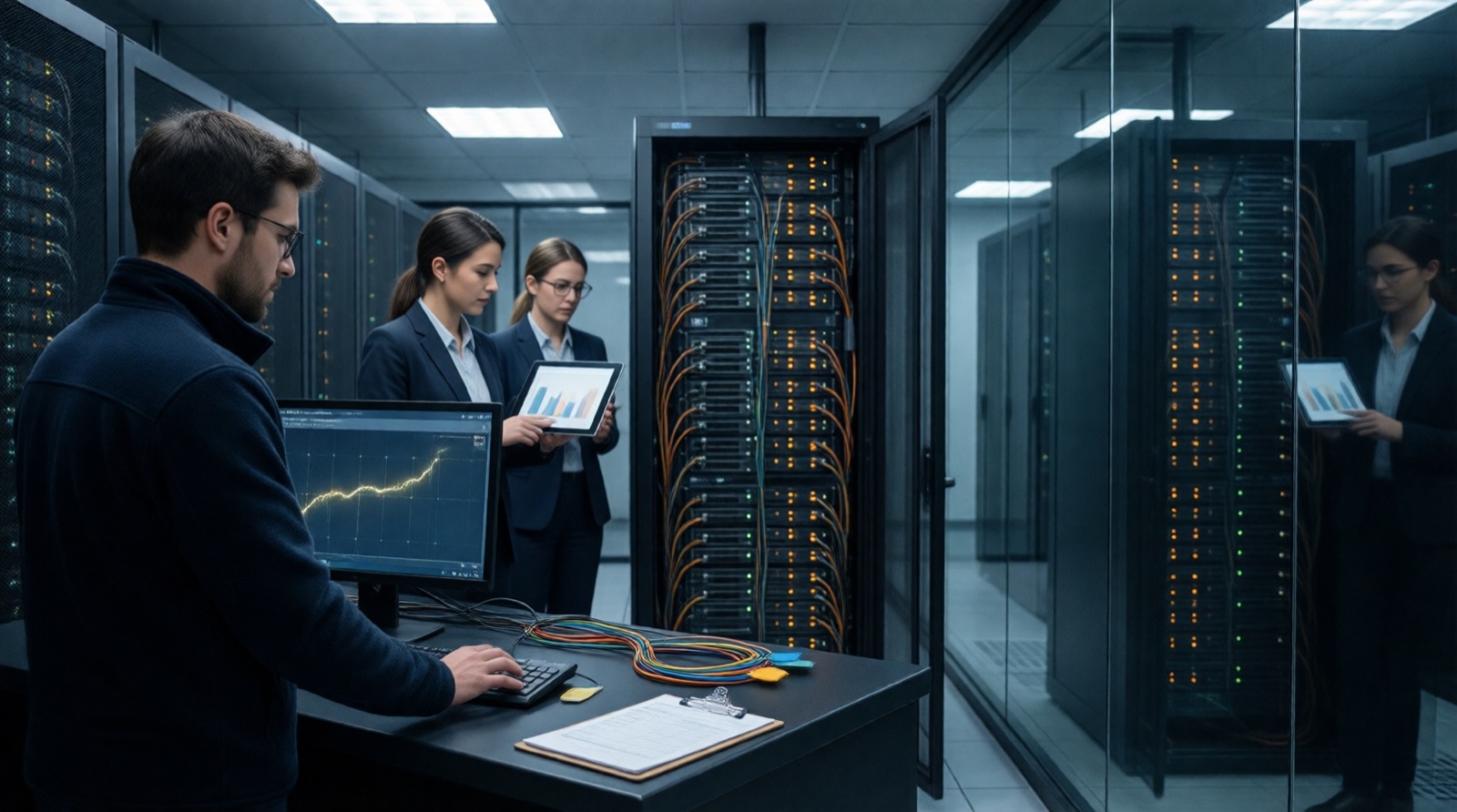
This chapter shows how Webspinner builds the control plane that makes sovereign AI measurable. It covers request-level telemetry and attribution, a FinOps practice for AI that follows the FinOps Foundation lifecycle, cost allocation with FOCUS and OpenCost, unit economics expressed as cost per successful task, and model right-sizing and routing on hardware the client owns. The aim is not a prettier dashboard. The aim is that every token, every task and every workload carries an owner, a cost and an outcome.
Telemetry at the request, not the invoice
Most enterprises first learn about AI cost from an invoice. By then the decision that created the cost has already been made, often several weeks earlier, by someone outside central IT. McKinsey describes exactly this pattern: business units purchase AI capabilities independently, employees build AI-powered workflows outside central IT, and citizen developers can unintentionally create autonomous agents that consume millions of tokens every day (Pankaj Sachdeva et al. 2026). The same research finds that 93 percent of respondents report exceeding their AI budgets, and that AI spend increases nearly fourfold as organizations move from isolated use cases to enterprise-wide adoption (Pankaj Sachdeva et al. 2026).
Exhibit 13
Every request carries an owner and an outcome

What to notice
- The engineer points at one traced request, not a monthly total: attribution is captured at the moment of inference.
- The invoice stack sits face down and unopened, because a bill aggregates by vendor and cannot name the workload.
- Blank cards and magnets on the board stand for workload, team and model version, the dimensions that make a request manageable.
An invoice cannot fix that. An invoice aggregates by vendor and by billing period. It does not tell you which workload, which team, which prompt template or which model version produced the spend. Attribution has to be captured at the moment of the request, not reconstructed afterwards from a bill.
Webspinner’s control plane instruments inference at the request level. OpenTelemetry collects traces, metrics and logs from the serving path. Prometheus stores the time series. Grafana renders them for operators, finance and platform teams. Each request carries dimensions that matter to the business: the workload it belongs to, the team or cost centre that owns it, the model and model version that served it, the prompt template revision, the token counts on input and output, latency, whether the task succeeded, and whether a human or a rule had to intervene.
That set of dimensions is what turns telemetry into attribution. A request that cannot be attributed to a workload is a request that cannot be managed, priced or defended in a budget review. Request-level attribution is the foundation for everything else in this chapter: the FinOps cycle, the cost allocation, the unit economics and the routing decisions.
A request that cannot be attributed to a workload is a request that cannot be managed, priced or defended in a budget review.
The market has moved in this direction. The FinOps Foundation’s 2026 survey reports that 98% now manage AI spend, up from 31% two years ago, and that AI cost management is the #1 skillset that teams need to develop (FinOps Foundation 2026). Visibility is no longer a nice-to-have for a small group of cost specialists. It is the operating condition for anyone running AI in production.
FinOps for AI: Inform, Optimize, Operate
Webspinner runs AI FinOps on the FinOps Foundation lifecycle rather than on a home-grown reporting process. The Foundation describes the discipline this way: “FinOps is performed by working iteratively on the Framework Capabilities through three phases: Inform, Optimize and Operate” (FinOps Foundation 2025a). The phases are not a waterfall. Teams cycle through them quickly, at different cadences, and the point is to build muscle memory so each cycle takes less time than the last (FinOps Foundation 2025a).
In practice, the three phases map onto three different questions.
- Inform. What did we spend, on what, for whom, and what did we get? This is where request-level telemetry becomes allocation, reporting, forecasting and unit economics (FinOps Foundation 2025a).
- Optimize. Where can the same outcome be produced for less? This is where right-sizing, routing, quantization, batching, caching and off-peak scheduling are evaluated and applied.
- Operate. Who acts on the numbers, on what cadence, with what budget and what policy? This is where showback and chargeback become routine, and where the platform team, finance and the business units agree on the rules.
Two open specifications do most of the heavy lifting on the data side.
FOCUS, the FinOps Open Cost and Usage Specification, is an open specification that normalizes billing datasets across AI, cloud, SaaS, data center and other technology vendors (FinOps Foundation 2025b). The value is a single schema. Without it, every source speaks its own dialect and the FinOps team spends its time on translation instead of decisions. The FinOps Foundation reports growing adoption of FOCUS as practitioners seek consistent, unified cost and usage data across an increasingly complex technology landscape, with AI workloads among the top expansion requests (FinOps Foundation 2026).
OpenCost handles the workload-level view. It is a Cloud Native Computing Foundation incubating project that provides real-time cost allocation broken down by Kubernetes concepts to the container level, with allocation for in-cluster resources including CPU, GPU, memory, load balancers and persistent volumes (OpenCost project 2025). It supports on-prem Kubernetes clusters using custom pricing, and it exports pricing data to Prometheus (OpenCost project 2025). That last detail matters for sovereign deployments. When the client owns the hardware, there is no cloud billing API to query. Custom pricing against owned capacity is the correct model, and OpenCost supports it.
Together, FOCUS and OpenCost give the control plane two views that finance and engineering can both accept: a normalized cost record that finance can reconcile, and a workload-level allocation that engineering can act on.
Unit economics: cost per successful task
Cost per token is a supplier metric. It tells you what the model vendor charges. It does not tell you what your business paid to get a piece of work done, because it ignores retries, failed tasks, escalations, idle GPU time and the engineering hours that keep the workload running.
Webspinner expresses unit economics as cost per successful task. The numerator is the full cost of the workload: GPU hours consumed, storage, the amortised cost of owned hardware, and the engineering time attached to that workload. The denominator is the number of tasks completed to the agreed quality bar. A task that failed, or that had to be retried three times, or that a human had to finish by hand, adds cost and no output. That asymmetry is the whole reason the metric is defined this way.
The FinOps Foundation places unit economics inside the Inform phase, alongside data ingestion, allocation, reporting and forecasting (FinOps Foundation 2025a). The framework is explicit that accurate allocation of spend and usage across any technology category is what enables accurate reporting (FinOps Foundation 2025a). Cost per successful task is the unit metric that makes AI comparable across workloads, across teams and across quarters.
From that metric, two financial mechanisms follow.
Showback reports cost back to the team or business unit that generated it, without moving money. It changes behaviour because it makes consumption visible to the people who control it. Chargeback moves the cost onto the owning unit’s budget. It changes behaviour because it makes consumption consequential.12
Both are applied by workload, not by department. A department-level number is too coarse to act on. A workload-level number has an owner, a budget and a set of levers attached to it.
Right-sizing and routing on owned hardware
The control plane’s optimization work happens on infrastructure the client owns or controls, with open-weight models. That changes the economics of optimization. On a metered cloud, the lever is usually to call the model less. On owned capacity, the lever is to serve the same work with fewer GPU-hours, or to serve more work with the same GPU-hours.
Exhibit 14
Routing keeps scarce GPU memory for hard work

What to notice
- The engineer sorts cards into two trays before work runs: routing decides which model each query reaches.
- The left rack glows dense while the right idles, reserving the largest model and scarcest GPU memory for work that needs it.
- The cart of sealed batch envelopes waits by the clock: off-peak scheduling flattens the peak capacity the client must buy.
vLLM is the serving layer. Its PagedAttention algorithm manages the key-value cache the way an operating system manages virtual memory, achieving near-zero waste in KV cache memory and flexible sharing of that cache within and across requests (Woosuk Kwon et al. 2023). The published evaluation shows vLLM improving throughput of popular models by 2-4× at the same level of latency compared with systems such as FasterTransformer and Orca (Woosuk Kwon et al. 2023). Throughput is the number that converts directly into cost per successful task on fixed hardware.
Around the serving layer, the control plane applies the standard set of inference optimizations. A survey of LLM inference systems describes the techniques as batching and scheduling, quantization, paged memory, eviction and offloading, and cache persistence, and notes that these techniques fundamentally rely on load prediction, adaptive mechanisms and cost reduction (James Pan et al. 2025). Each of these is a lever the platform team can pull per workload, and each shows up as a change in the unit metric.
Routing is the other lever. A router assigns queries to a small or large model based on predicted query difficulty and the desired quality level, and that quality level can be tuned at test time to trade quality for cost as the scenario requires (Dujian Ding et al. 2024). In the published experiments, the approach allowed up to 40% fewer calls to the large model, with no drop in response quality (Dujian Ding et al. 2024). On owned hardware this is not about avoiding a per-token bill. It is about reserving the largest model and the scarcest GPU memory for the work that actually needs them, and letting the smaller model absorb the rest.
Scheduling completes the picture. Evaluation runs, fine-tuning, re-indexing and batch scoring do not need to compete with interactive traffic. Moving that work off-peak flattens the peak capacity requirement, which reduces the hardware the client has to buy. Because the delivery model contains no rented frontier AI and no metered cloud, consumption pricing and token bills are replaced by owned capacity, and the optimization work converts directly into lower cost per successful task rather than into a smaller invoice from a vendor.
That is the control plane in one sentence: telemetry that attributes every request, a FinOps cycle that turns attribution into allocation, unit economics that express value per completed task, and optimization that runs on hardware the client controls.
Key takeaways
- Invoice-level reporting cannot attribute AI spend. Request-level telemetry with OpenTelemetry, Prometheus and Grafana attaches every request to a workload, a team, a model version and an outcome.
- AI FinOps follows the FinOps Foundation lifecycle of Inform, Optimize and Operate, cycled quickly rather than run as a one-off audit (FinOps Foundation 2025a).
- FOCUS normalizes cost and usage data across AI, cloud, SaaS and data center, and OpenCost provides container-level allocation including GPU and on-prem clusters with custom pricing (FinOps Foundation 2025b; OpenCost project 2025).
- Cost per successful task is the unit metric. Showback and chargeback by workload turn that metric into behaviour.
- Right-sizing and routing on owned hardware — vLLM, quantization, batching, caching, off-peak scheduling and quality-aware routing — convert optimization into lower cost per task rather than a smaller vendor bill (Woosuk Kwon et al. 2023; James Pan et al. 2025; Dujian Ding et al. 2024).
Chapter 8Procedure, durable memory, and reliability engineering

A model that answers well is not a system that behaves well. This chapter shows how Webspinner turns inference into a governed production workload. It covers the operating principle — the model proposes, rules decide, and the workflow guarantees — then the machinery underneath it: durable execution for long-running work, business decisions expressed as versioned and tested rules, release gates that protect quality and judgment, durable memory that survives model changes and staff changes, and reliability engineering aimed at five nines.
The model proposes, rules decide, workflow guarantees
Most enterprise AI failures are not model failures. They are structural failures: a probabilistic component was given authority it should never have had, and nothing around it recorded, constrained, or recovered from what it did.
Webspinner separates three things that are usually tangled together.
The model proposes. A language model drafts, classifies, extracts, summarizes, and suggests. It is treated as a proposal engine — useful, variable, and never authoritative on its own.
Rules decide. The decision that carries consequence — approve or reject, price or decline, route or escalate, pay or hold — is written as an explicit rule. That rule is versioned, tested, and readable by the business. The model’s output is an input to the rule, not a replacement for it.
The workflow guarantees. The sequence of steps, the retries, the timeouts, the compensation path, and the audit record are owned by the workflow engine, not by the prompt.
This matters because the failure modes of machine learning systems are structural. Sculley and colleagues catalogued them as technical debt: boundary erosion, entanglement, hidden feedback loops, undeclared consumers, data dependencies, and configuration issues (D. Sculley et al. 2015). None of those are fixed by a better model. They are fixed by design.
Procedure also bounds cost. McKinsey describes business units buying AI independently and citizen developers building agents that can consume millions of tokens every day (Pankaj Sachdeva et al. 2026). A workflow with a defined step count, a defined budget, and a defined exit is a smaller blast radius than an agent with an open-ended loop.
Durable execution and versioned rules
Long-running work is where AI systems quietly break. A task that spans hours, several systems, and a human approval does not survive a pod restart, a network partition, or a vendor timeout unless something is holding its state.
Exhibit 15
A crash costs a step, not a transaction

What to notice
- The lit mid-sequence block shows execution resuming from the last recorded event, not restarting the workflow.
- The open rack and dark aisle make the failure real: the process died, the persisted state did not.
- The runbook on the cart marks retries, timeouts, heartbeats and compensation as owned procedure, not improvisation.
Webspinner builds these workloads on Temporal, under the MIT licence. Temporal is a runtime for durable function executions; it maintains the state and progress of a workflow execution through failures, crashes, and server outages by recording an event history at each step, so execution resumes from the last recorded event rather than restarting (Temporal Technologies 2025).13
Four controls do most of the work:
- Retries absorb transient failures — a rate limit, a dropped connection, a slow downstream API — without failing the task.
- Timeouts stop a hung step from holding a workflow open indefinitely.
- Heartbeats let a long-running activity report that it is still alive, so the platform can tell slow from dead and reassign work that has genuinely stalled.
- Compensation reverses committed steps in order when a later step fails, so a partial transaction does not leave the business in an inconsistent state.
Rules sit alongside the workflow. Webspinner expresses business decisions as versioned, tested rules using Drools and Apache KIE. A rule change is a reviewed diff with a test run behind it, not an edit to a prompt that nobody outside the team can see. When a regulator, an auditor, or a risk committee asks why a case was declined in March, the answer is a rule version and a decision record — not a reconstruction.
That is also where trustworthiness becomes checkable rather than aspirational. The NIST AI Risk Management Framework is intended to improve the ability to incorporate trustworthiness considerations into the design, development, use, and evaluation of AI systems (National Institute of Standards and Technology 2023). Rules are the most concrete place to do that: they are the point where policy becomes executable and testable.
Release gates and human approval
Nothing reaches production because it looked good in a demonstration. Webspinner runs every workload through a release gate before it serves real work.
Exhibit 16
A person signs where judgment carries cost

What to notice
- The stylus on the tablet is the approval record: who decided, what they saw, and when.
- Two trays, pending and approved, show the gate holding work until a person acts.
- The rule version card beside the folder pins the release to the exact rules it shipped with.
- Schema validation. Inputs and model outputs are validated against an explicit schema. A malformed or out-of-range output fails closed, not silently downstream.
- Evaluation gates. A fixed evaluation set runs against the candidate model, prompt, and rules combination. Regression blocks release.
- Rules pinning. The release records the exact rule version it ships with, so behaviour can be reproduced.
- Human approval record. Where judgment belongs to a person, the workflow pauses and records who approved, what they saw, and when.
- Rollback path. The previous configuration remains deployable, and the rollback is rehearsed rather than assumed.
The research direction here is consistent. SKILL.nb describes governing reusable agent workflows with versioned, auditable artifacts that interleave natural-language guidance, executable cells, validation gates, and fallback paths, with execution evidence deciding which steps become code and which stay guided (Amine El Hattami et al. 2026). Its reported results include retaining 91.7% of initially successful tasks across three re-executions (Amine El Hattami et al. 2026). The lesson is not the number. The lesson is that gates and versioning are reliability mechanisms, not paperwork.
This is also ordinary MLOps discipline. A review of the MLOps landscape identifies experiment tracking, model deployment, and model inference as core capabilities of a robust platform, alongside workflow orchestration and performance monitoring (Lisana Berberi et al. 2025). Webspinner’s gates are that discipline applied to a governed production service rather than to a notebook.
Human approval is placed deliberately. Hiring, credit, clinical, and contractual exception decisions get a person in the loop with a recorded rationale. High-volume, low-consequence classification does not. The rule is simple: if the cost of being wrong is borne by a person, a person decides.
Durable memory with provenance
AI systems drift for a mundane reason: the world moves and the system’s context does not. Staff leave, policies change, a supplier renegotiates, and the knowledge that shaped last year’s decisions is gone.
Webspinner keeps durable memory in PostgreSQL with pgvector. It stores three kinds of content: decisions recorded in the client’s own words, lessons learned when a workflow failed or was corrected, and measured state such as volumes, error rates, and outcomes. Retrieval returns the item together with its provenance — source, timestamp, author, and the workflow step that used it.
Provenance is the hard part, and it is a known open problem. Lewis and colleagues note that providing provenance for model decisions and updating world knowledge remain open research problems, and describe retrieval-augmented generation as combining parametric memory in the model with non-parametric memory in an external index (Patrick Lewis et al. 2020). Webspinner’s memory is deliberately the non-parametric side: it lives in the client’s database, under the client’s control, and it can be inspected, corrected, and exported.14
Memory informs. It does not govern. What must always hold — a spending limit, a segregation-of-duties check, a regulatory threshold — is enforced by a rule, never by recall. A retrieved precedent can shape a recommendation; it cannot authorize a payment.
Memory is also a data dependency, and it needs the same governance as code. Sculley and colleagues list data dependencies and hidden feedback loops among the risks that make machine learning systems expensive to maintain (D. Sculley et al. 2015). A memory store that quietly ingests its own outputs is a feedback loop with a retention policy. Webspinner treats it accordingly: versioned writes, reviewable corrections, and retention rules the client sets.
Reliability engineering toward five nines
Reliability is engineered, not hoped for. Webspinner targets five nines for the procedural path, using deterministic components: idempotent steps, automatic retries, redundancy with health checks, graceful fallback, service objectives, and error budgets.
The target is chosen per workload, because reliability has a price. Google’s SRE practice notes that extreme reliability comes at a cost: maximizing stability limits how fast features can be developed and dramatically increases cost (Marc Alvidrez 2016). The same chapter makes the point plainly — a user on a 99% reliable smartphone cannot tell the difference between 99.99% and 99.999% service reliability (Marc Alvidrez 2016). So the question is not “how reliable can we be” but “where does reliability change an outcome the business cares about.” The procedural path — the rules, the workflow state, the decision record — gets the five-nines treatment. A summarization step that a human reviews before use does not need it.
Three engineering commitments carry most of the weight.
Idempotency. Retries are only safe if repeating a step does not duplicate its effect. Webspinner designs steps with idempotency keys and deduplication at the system boundary, so a retried payment instruction posts once.
Graceful fallback. If a model is unavailable, or its output fails schema validation, the workflow falls back to a rules-only path or queues the case for human review. The service degrades; it does not stop.
Service objectives and error budgets. An error budget is the amount of unreliability a service is allowed to spend over a period. It converts reliability from an argument into an accounting rule, and it gives engineering and the business a shared number to manage against.
The important framing is this: the model is not the reliability boundary. Model quality will vary with version, prompt, and input distribution. The workflow’s guarantees do not. That separation is what makes an AI workload something a CIO can put in front of a risk committee and an auditor — and, in regulated environments where harmonised rules apply (Regulation (EU) 2024/1689 Laying down Harmonised Rules on Artificial Intelligence (Artificial Intelligence Act) 2024), something that can be documented and defended.
Key takeaways
- The model proposes, rules decide, and the workflow guarantees. Authority sits with versioned, tested rules, not with a probabilistic component.
- Durable execution on Temporal gives long-running AI work retries, timeouts, heartbeats, and compensation, so a crash costs a step rather than a transaction.
- Release gates — schema validation, evaluation, rules pinning, human approval, and a rehearsed rollback — protect quality and keep judgment with people.
- Durable memory in PostgreSQL with pgvector keeps decisions, lessons, and measured state under the client’s control, retrieved with provenance; what must always hold is enforced by rules, never by recall.
- Reliability is engineered toward five nines on the procedural path through idempotency, retries, redundancy, fallback, service objectives, and error budgets — with the target set per workload, because reliability has a cost.
The model proposes, rules decide, and the workflow guarantees. Authority sits with versioned, tested rules, not with a probabilistic component.
Part 3
The value that keeps growing
Chapter 9Engagement model and quarterly value reviews

This chapter shows how Webspinner prices and runs the relationship after the pilot. It covers four things: who does the work and where they sit, what the meter counts, how fees and outcomes are fixed, and how a quarterly value review keeps return on investment visible against a baseline agreed at the start. The aim is simple. You should be able to read a Webspinner invoice and a Webspinner value review and know exactly what you paid for, what you got, and what changes next quarter.
Senior talent, local to the client
Most enterprise AI programmes do not fail because the model was wrong. They fail because the people who built the pilot moved on, and nobody left behind could operate the thing. Research on IT outsourcing success points the same way. A study of 152 large U.S.-based organizations found that relationship management capabilities influence outsourcing success through the successful delivery of IT services, and that this mediating path held where the equivalent path through contract management capabilities did not (Forough Karimi-Alaghehband and Suzanne Rivard 2020). Contracts matter. The relationship is what carries delivery.
Webspinner’s engagement model is built around that finding. Senior talent is local to the client. The people who scope the sovereignty boundary, design the control plane, and write the procedures around inference sit with your teams, in your time zone, in your review cycles. They are not a rotating pool assigned by ticket queue.
Local senior talent usually carries a local price. Webspinner’s model does not, because automation absorbs the work that normally justifies a large delivery team. Telemetry wiring, evaluation runs, cost allocation, report generation, regression checks, and upgrade rehearsals are executed by tooling that Webspinner has already built and operates. What remains for a person is judgment: which workload to take next, which rule should decide, which failure mode deserves an error budget, which trade-off the business will accept. That is the work we charge for, and it is why rates are comparable to offshore delivery without the handover risk that comes with distance.
The client side of this is not passive. Work on managed security services models the engagement as a collaborative service whose quality is shaped by the contribution of both the provider and the client, and finds that bilateral liability-based contracts can reach the first-best outcome when post-breach effort verification is feasible (Kai-Lung Hui et al. 2019). The same logic applies to AI production workloads. Webspinner owns the platform, the procedures, and the reliability engineering. The client owns the business rules, the data boundaries, and the approval decisions. Both sides carry obligations, and both sides can verify whether the other met them.
The meter runs only while a person is focused on your work
The second structural choice is what the meter counts. Webspinner bills time only while a person is focused on the client’s work. Machine time is never billed. Pipelines, training runs, fine-tuning, evaluation sweeps, load tests, and upgrade rehearsals consume compute on capacity the client owns or controls, and none of that appears on a Webspinner invoice.15
Exhibit 17
Machine time stays off the invoice

What to notice
- Blinking compute racks run unattended: machine time sits on client-owned capacity and never becomes a Webspinner invoice line.
- The desk timer beside one notebook marks focused human attention, the only thing the meter counts.
- The blank invoice tray shows fixed fees: heavy evaluation or inference volume adds no variable charge.
This is a deliberate contrast with the consumption economics that dominate enterprise AI today. McKinsey’s QuantumBlack describes organizations discovering that AI costs can spiral far faster than traditional technology spending, with some companies exhausting annual AI budgets in a matter of months and much of the spend remaining invisible as business units buy capabilities independently (Pankaj Sachdeva et al. 2026). The same analysis notes that 93 percent of surveyed respondents report exceeding their AI budgets, and that a majority expect AI spend to increase by at least 25 percent over the next 12 months (Pankaj Sachdeva et al. 2026). When the meter is a token counter, every experiment is a purchase and every agent is a standing order.
The FinOps community has moved in the same direction. The State of FinOps 2026 report finds that FinOps for AI is the top forward-looking priority, that AI cost management is the #1 skillset teams need to develop, and that 98% now manage AI spend, up from 31% two years ago (FinOps Foundation 2026). Cost control is no longer a finance afterthought appended to a programme. It is part of the design.
Webspinner’s answer is to remove the variable meter from the delivery relationship entirely. You pay for attention, not for tokens. A month in which the platform runs a heavy schedule of evaluation sweeps and a large volume of inference requests costs you nothing extra in Webspinner fees, because the platform is yours and the compute is yours. What you buy is the senior person who reads the results and decides what to change.
What you buy is the senior person who reads the results and decides what to change.
Fixed fees with guaranteed, agreed outcomes
Engagements use fixed fees with guaranteed, agreed outcomes. That sentence is easy to write and hard to honour, because it forces both sides to define the outcome before work begins.
Measurement is the hard part. A review of analytical models for return on investment in regulated service sectors finds that compliance constraints and data limitations often obscure measurement accuracy, and that econometric, probabilistic, and machine-learning models are used to integrate fragmented data and adjust for attribution biases (Joanne Osuashi Sanni et al. 2020). The same review notes that hybrid models combining econometric precision with AI-based forecasting improve ROI predictability in environments with high compliance overheads (Joanne Osuashi Sanni et al. 2020). The lesson for an AI programme is direct. If the outcome is not defined in measurable terms at the start, the value review at the end becomes an argument about attribution.
Webspinner therefore fixes the outcome in the terms the FinOps lifecycle already uses. The Inform phase examines technology cost, usage, and efficiency data, and the unit economics capability connects that data to business value (FinOps Foundation 2025a). Webspinner applies the same discipline to AI workloads, with unit economics expressed as cost per successful task rather than cost per token.16
A fixed fee against a defined outcome changes behaviour on both sides. Webspinner cannot recover an overrun by billing more hours, so the incentive is to design the workload correctly the first time. The client cannot expand scope silently, because scope is written into the outcome. Work on bilateral liability contracts makes the same point from the other direction: when the provider assumes limited liability, contracts that allocate responsibility across both parties are more efficient than a multilateral contract that spreads it thinly (Kai-Lung Hui et al. 2019).
Quarterly value reviews against an agreed baseline
The relationship is ongoing, and the review cadence is quarterly. Each review compares progress against a baseline agreed at the start of the engagement: the cost per successful task, the volume and mix of work, the error budget consumption, the human approval rate, the incident record, and the exit readiness of the workload.
Exhibit 18
Baseline anchors the quarterly decision

What to notice
- The pinned baseline strip stays fixed: the agreed unit metric and quality bar anchor every quarterly comparison.
- Colored markers sit beside the strip: actual cost per successful task is compared with baseline, not with activity.
- Incident cards and decision slips share the table: each number in the review ends with a next-quarter action.
The FinOps Framework describes practitioners cycling through Inform, Optimize, and Operate rapidly, examining the current state of the environment, identifying and documenting ways it could be improved, and enabling the individuals who can enact those changes (FinOps Foundation 2025a). It also notes that quick action on a regular cadence helps teams avoid analysis paralysis (FinOps Foundation 2025a). A quarterly review is that cadence made contractual.
Each review covers four things:
- Baseline versus actual. The agreed unit metric, the agreed volume, and the agreed quality bar, compared with what the platform actually recorded through request-level telemetry and attribution.
- Spend and capacity. What the workload consumed on owned capacity, what it would have cost under a metered model, and where headroom exists for the next workload.
- Reliability and control. Error budget consumption, incident review, approval rates, rule changes, and evaluation gate results since the last review.
- Decisions for the next quarter. Which workload moves next, which optimisation is worth doing, which rule or procedure changes, and what the client wants to stop doing.
The point of the review is not reporting for its own sake. The State of FinOps 2026 report finds that practitioners with executive alignment show 2-4x more influence over technology selection decisions, and that FinOps is no longer just explaining past spend but shaping future technology decisions before commitments are made (FinOps Foundation 2026). A quarterly value review is where that shift happens inside a Webspinner engagement. The conversation moves from what the last quarter cost to what the next quarter should be.
McKinsey frames the same objective for CIOs managing AI demand at scale: optimise for outcomes, not just cost (Pankaj Sachdeva et al. 2026). A value review that only reports spend misses the point. A value review that reports cost per successful task, against a baseline, with a decision attached to each number, is the mechanism that keeps a programme measured on value rather than on activity.
The relationship is designed to run past the first year. The Sovereignty Assessment sets the boundary and the total cost of ownership. The 90-Day Pilot to Production turns one high-value workload into a governed, recoverable service. The Managed Sovereign Platform keeps it operating, evaluated, rehearsed, and upgraded. Each quarter’s review is the checkpoint where the next commitment is made against evidence rather than optimism, and where the target is to exceed the agreed baseline rather than merely meet it.
Key takeaways
- Senior talent is local to the client, and automation absorbs the repeatable work so rates stay comparable to offshore delivery without the handover risk that comes with distance.
- The meter runs only while a person is focused on the client’s work. Machine time for pipelines, training, fine-tuning, and evaluation runs is never billed.
- Engagements use fixed fees with guaranteed, agreed outcomes, defined in measurable terms before work begins so the value review rests on evidence rather than attribution argument.
- Quarterly value reviews compare progress against an agreed baseline using unit economics such as cost per successful task, and each review ends with decisions for the next quarter.
- The relationship is ongoing, aimed at exceeding expectations and improving return on investment quarter after quarter.
Chapter 10Offers and the managed path to production

Most enterprise AI programmes do not fail at the demo. They fail in the gap between a promising pilot and a service the business can depend on. This chapter sets out how Webspinner closes that gap: a short assessment that fixes the boundary and the numbers, a 90-day pilot that turns one workload into a governed and recoverable service, and a managed platform that keeps it running. It also describes the part that matters most over time — the quarterly value review, and the working relationship built around it.
Start with the boundary: the Sovereignty Assessment
The Sovereignty Assessment runs two to three weeks. It is deliberately short. The purpose is not to produce a strategy document. It is to answer the questions that decide whether a workload should go to production at all, and on what terms.
Exhibit 19
The boundary is drawn before the pilot

What to notice
- The red rope encloses data, model and user tokens, marking where client control stops.
- Threat cards pinned by the risk officer turn trustworthiness into specific, proportionate controls for this workload.
- The finance analyst's scale compares owned capacity with alternatives, including the operating effort owned capacity implies.
The assessment produces six outputs:
- Boundary. Which data, models, users and systems the workload touches, and where the line of client control sits.
- Threat model. What can go wrong, who can cause it, and which controls are proportionate to the risk.
- Workload selection. Which candidate workload has enough value, enough volume and enough determinism to justify production.
- TCO. The full cost of owned capacity against the alternatives, including the operating effort that owned capacity implies.
- Exit plan. How the client leaves, changes supplier or moves platform without losing the workload.
- Readiness score. A single view of how ready the organisation is, dimension by dimension.
Readiness is not a feeling. It can be assessed against defined dimensions. Holmström’s AI readiness framework is intended to assist assessment of organisational AI readiness — an organisation’s ability to deploy AI technologies to enable digital transformation — across four key dimensions: technologies, activities, boundaries and goals, and can facilitate analysis both of an organisation’s current sociotechnical AI status and of the prospects for the technology’s fuller value-adding, sociotechnical deployment (Jonny Holmström 2021). The readiness score in the assessment is built on that logic. It tells the client which dimension is the constraint, so the pilot is scoped around the real bottleneck rather than the most enthusiastic sponsor.
The threat model is where the assessment earns its keep. NIST’s AI Risk Management Framework is intended for voluntary use and to improve the ability to incorporate trustworthiness considerations into the design, development, use and evaluation of AI products, services and systems (National Institute of Standards and Technology 2023). That is the right frame for a threat model: not a compliance checklist, but a structured account of what trustworthiness means for this workload, in this organisation, under this regulator. Where the workload falls inside a regulated category, the boundary work also has to account for the harmonised rules laid down by the EU Artificial Intelligence Act (Regulation (EU) 2024/1689 Laying down Harmonised Rules on Artificial Intelligence (Artificial Intelligence Act) 2024).
The exit plan is not an afterthought. Dependency on a supplier is measurable, and it has financial consequences. The CVL framework for cloud vendor lock-in prediction evaluates dependency using weighted factors that include service costs, data transfer expenses, security features, compliance adherence, scalability and technical integrations (Amal Alhosban et al. 2024). An exit plan built on those factors is concrete: it names what would have to move, what it would cost to move it, and how long the move would take. A client that cannot answer those questions does not control its AI. It rents it.
The assessment also surfaces spend that nobody has been counting. McKinsey reports that business units purchase AI capabilities independently and that employees build AI-powered workflows outside central IT, and that 93 percent of respondents report exceeding their AI budgets (Pankaj Sachdeva et al. 2026). A two-to-three-week assessment will not fix that. It will, however, put a number and an owner against the workloads that matter, which is the precondition for fixing it.
The 90-Day Pilot to Production
The 90-Day Pilot to Production takes one high-value workload and turns it into a governed, recoverable service. One workload, not five. The constraint is deliberate: a pilot that proves governance on a single workload is worth more than a demonstration that proves nothing.
The constraint is deliberate: a pilot that proves governance on a single workload is worth more than a demonstration that proves nothing.
Exhibit 20
One workload proves recoverability

What to notice
- The pulled cable and the second server taking over show failover being exercised, not assumed.
- Colored tokens on retry and compensation lanes make a failed step recoverable without hand reconstruction.
- The approval card sits at the judgment point, while versioned rule cards keep decisions testable.
A service is recoverable when a failed step can be retried, compensated or rolled back without a person reconstructing state by hand.17 That definition shapes the whole 90 days.
The pilot builds three layers.
The control plane. Request-level telemetry and attribution run on OpenTelemetry, Prometheus and Grafana. FinOps for AI follows the FinOps Foundation lifecycle of Inform, Optimize and Operate (FinOps Foundation 2025a). Cost data is normalised with FOCUS and OpenCost. Unit economics are expressed as cost per successful task, with showback and chargeback by workload. This is the layer that answers the question that stalled the leadership meeting McKinsey describes, where an approved AI capability reached implementation and nobody in the room knew what it would cost (Pankaj Sachdeva et al. 2026).
The procedure. The model proposes, rules decide, workflow guarantees. Durable long-running workflows are built on Temporal under the MIT licence, with retries, timeouts, heartbeats and compensation. Business decisions are versioned, tested rules in Drools and Apache KIE. Schema validation and evaluation gates sit before every release. Human approval is placed where judgment belongs, not where it is convenient.
The memory. Decisions are kept in the client’s own words, alongside lessons learned and measured state, in PostgreSQL with pgvector and retrieved with provenance. What must always hold is enforced by rules, never by recall. This is the defence against drift: the system does not gradually forget what the business decided.
Running underneath all three is model right-sizing on owned hardware. Open-weight models are served with vLLM, with quantization, batching, caching and scheduling of work off-peak. There is no rented frontier AI and no metered cloud in the delivery model, so consumption pricing and token bills are replaced by owned capacity. The capacity is sized during the assessment and measured during the pilot.
Reliability is engineered toward five nines through deterministic, procedural components: idempotent steps, automatic retries, redundancy with health checks, graceful fallback, service objectives and error budgets. Error budgets matter because reliability is not free. Google’s SRE practice notes that extreme reliability comes at a cost, and that past a certain point increasing reliability is worse for a service and its users rather than better (Marc Alvidrez 2016). An error budget makes that trade-off explicit and agreed, rather than discovered during an incident.
None of this is exotic. It is the ordinary discipline of production software, applied to a workload that many organisations have been running as an experiment. The MLOps literature makes the same point from the other direction: managing and monitoring models in production has become essential, and every aspect of the machine learning life cycle — from workflow orchestration to performance monitoring — presents challenges that require sophisticated, flexible and scalable solutions (Lisana Berberi et al. 2025). The pilot is where those solutions are installed and proven on one workload.
The pilot is a fixed-fee engagement with agreed outcomes. The exit criteria are written at the start, not negotiated at the end.
The Managed Sovereign Platform
The Managed Sovereign Platform is what happens after the pilot proves the pattern. It covers four things: operations, evaluation, continuity rehearsals and upgrades.
Operations means the platform is run against its service objectives, with the telemetry, error budgets and on-call discipline established in the pilot. It also means the FinOps cycle keeps turning. The FinOps Foundation describes practitioners cycling through Inform, Optimize and Operate rapidly, examining the current state of the environment, identifying improvements, and enabling the changes that drive the most value (FinOps Foundation 2025a). That cadence is the operating rhythm of the platform, not a quarterly report.
Evaluation means the workload is tested against a maintained suite before any change reaches production. Model upgrades, rule changes and prompt changes all pass through the same gates. Evaluation is a standing capability, not a one-off exercise at go-live.
Continuity rehearsals mean recovery is exercised on a schedule rather than assumed. Failover is performed. Restores are performed. Compensation paths are performed. A plan that has never been run is a hypothesis.
Upgrades mean the platform absorbs change in its components and in its obligations. Frameworks move: NIST’s AI Risk Management Framework is being revised as part of the White House AI Action Plan (National Institute of Standards and Technology 2023). Regulations move too: the EU Artificial Intelligence Act is in force and has been amended, with a current consolidated version dated 27/07/2026 (Regulation (EU) 2024/1689 Laying down Harmonised Rules on Artificial Intelligence (Artificial Intelligence Act) 2024). A platform that cannot absorb those changes becomes a liability with a support contract.
One governed path, reviewed quarterly
The three offers are not a menu. They are one path. The assessment sets the boundary, the threat model and the numbers. The pilot takes one workload across that boundary and proves it can be governed and recovered. The managed platform keeps it governed and recovered while the business changes. Each stage produces the inputs the next stage needs, and each stage has a defined end.
The commercial model matches the path. Webspinner works with senior talent local to the client. Automation lets us charge rates comparable to offshore delivery. The meter runs only while a person is focused on the client’s work, and machine time — pipelines, training, fine-tuning, evaluation runs — is never billed. Engagements are fixed-fee with guaranteed, agreed outcomes. Webspinner is based in Portland, Oregon.
The relationship is reviewed quarterly against an agreed baseline. That baseline is set during the assessment and refined during the pilot: cost per successful task, service objectives met, incidents and their causes, workload adoption, and the business outcome the workload was chosen to move. The review is not a status meeting. It is the point at which the platform is re-aligned to the business, or the scope is changed.
This is the same discipline McKinsey describes when it frames tokenomics as FinOps for AI — a way to actively and continuously predict and manage AI model usage to maximise return on investment (Pankaj Sachdeva et al. 2026). Continuous is the operative word. A cost model built once and never revisited describes a platform that no longer exists.
The aim of the ongoing relationship is straightforward: to exceed expectations and deliver return on investment, quarter after quarter, on a platform the client owns and controls.
Key takeaways
- The Sovereignty Assessment runs two to three weeks and produces six outputs: boundary, threat model, workload selection, TCO, exit plan and readiness score.
- The 90-Day Pilot to Production turns one high-value workload into a governed, recoverable service, with the control plane, procedure and durable memory installed and proven.
- The Managed Sovereign Platform covers operations, evaluation, continuity rehearsals and upgrades, so the workload stays governed as models, frameworks and regulations change.
- The three offers form one governed path, with each stage producing the inputs the next stage needs.
- Quarterly value reviews against an agreed baseline keep the platform aligned to business outcomes, and the relationship is built to run for years rather than to close a sale.
Endnotes
Cost per successful task divides total run cost — inference, orchestration, infrastructure, retries and human review — by the number of tasks that completed to specification. A cheap model that fails often is an expensive model.↩︎
Tokens are not words. A short prompt may be a few hundred tokens; a long document with retrieved context may be tens of thousands, and an agent that re-reads its own history on every step multiplies that cost across the loop.↩︎
The FinOps Foundation describes the phases as a rapid cycle rather than a one-off project: examine the current state, identify improvements, then enable the people who can act on them.↩︎
An agentic workflow is a chain of model calls with tool use and intermediate state, rather than a single prompt and response. The chain length is a design decision, and it drives cost more than the model choice does.↩︎
Cost per token tells you what you paid. Cost per successful task tells you what you got. The second is the number a CFO can compare across workloads.↩︎
A shadow agent is an agent built and operated outside any register or review process. An orphaned agent is one whose original owner has moved on, but which continues to run, hold credentials and consume capacity. Both are common wherever agents can be created without a provisioning step.↩︎
Drift, in this book, means any change that moves system behaviour away from business intent — model updates, data change, prompt edits, rule changes, or shifts in the external world. The cause matters less than whether the change is detectable and attributable.↩︎
An error budget is the amount of unreliability a service objective permits over a period. It converts reliability from an argument into an allowance that engineering and product can spend together.↩︎
An exit plan is a tested procedure for running a workload elsewhere, with an agreed trigger, a cost estimate, and a named owner. A plan that has never been rehearsed is a document, not a capability.↩︎
An open-weight model is one whose trained parameters are published, so the client can download, host, fine-tune, and evaluate it inside its own boundary rather than calling a vendor’s hosted endpoint.↩︎
Quantization stores model weights and activations at lower numerical precision than the original training format. It reduces memory footprint and can raise throughput, at some cost in accuracy that must be measured rather than assumed.↩︎
Showback and chargeback are standard FinOps allocation mechanisms. Showback informs; chargeback transfers. Most enterprises start with showback and move to chargeback once the allocation model has survived a quarter or two of scrutiny.↩︎
Durable execution means the workflow’s position is persisted, not just its inputs. After a crash, the system knows which steps completed and which did not, and continues from there.↩︎
pgvector is an open-source vector extension for PostgreSQL. Embeddings and business records sit in the same database, so a retrieval result can be joined to the transaction it relates to.↩︎
Machine time means compute consumed by data pipelines, training, fine-tuning, evaluation runs, load tests, and upgrade rehearsals. Under Webspinner’s delivery model it runs on owned or controlled capacity and is never billed by Webspinner.↩︎
Cost per successful task divides the full cost of running a workload by the number of tasks that completed correctly and met the agreed quality bar. Failed tasks, retries, and human corrections are included in the numerator. It is the unit metric Webspinner uses in quarterly value reviews.↩︎
Recoverability is a property of the workflow, not of the model. It requires durable state, idempotent steps and defined compensation for each step that has a side effect.↩︎
Bibliography
Index
Numbers are chapters; each opens the section that discusses the term.
#
A
- agentic consumption1, 2
- AI control plane1, 6
- AI cost spiral1
- AI FinOps4, 6, 7
- AI governance1, 2, 4
- AI sprawl1, 3, 4
- Apache KIE1, 8, 10
B
C
- chargeback1, 2, 3, 4, 6, 7, 10
- citizen developers1, 3, 4, 7
- cloud sprawl4
- consumption pricing1, 2, 6, 7, 10
- cost per successful task1, 3, 5, 6, 7, 9, 10
D
E
F
G
H
M
O
- off-peak scheduling5, 6, 7
- open-weight models1, 3, 5, 6, 7, 10
- OpenCost1, 6, 7, 10
- OpenTelemetry1, 6, 7, 10
- owned capacity1, 2, 3, 5, 6, 7, 9, 10
P
Q
R
S
- service objectives1, 4, 5, 8, 10
- showback1, 3, 4, 6, 7, 10
- sovereign AI1, 3, 5, 6
- Sovereignty Assessment1, 9, 10
T
U
V